French Words: 101+ Common Words with English Meanings

Learning French Words is the first step toward a successful French language student journey for every learner. Speak confidently and understand French culture, and have access to educational, travel and professional opportunities worldwide. For students, professionals and language learners, developing a functional vocabulary will provide you with the means to express yourself in a natural manner.
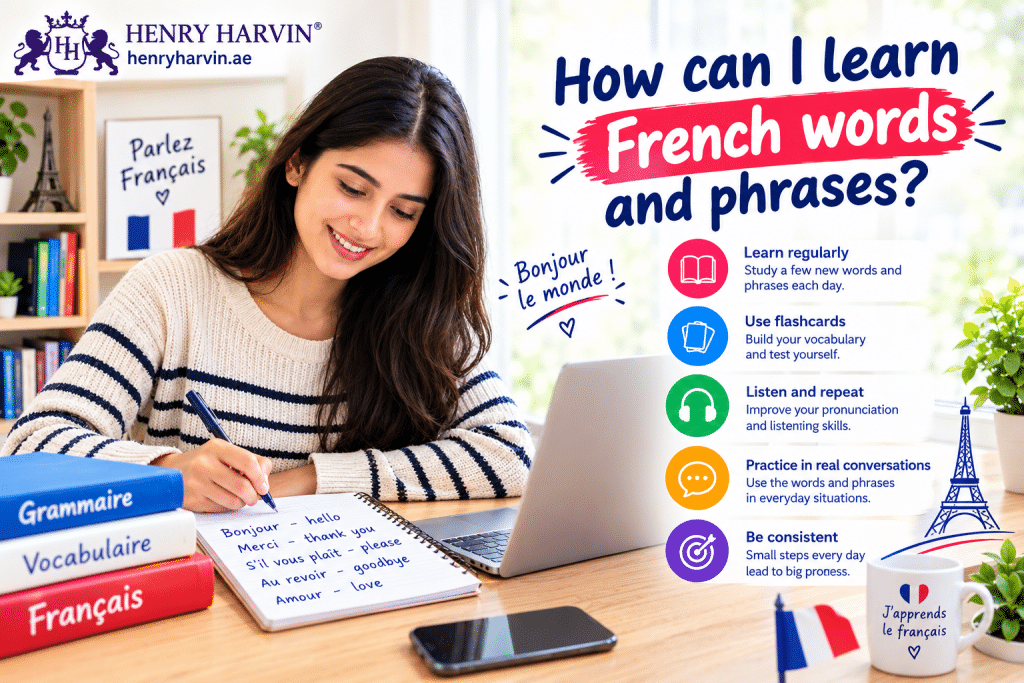
To begin your journey into the language of France, you should learn everyday nouns, commonly used verbs, basic french greetings and simple phrases. This blog includes over 101 frequently used French words along with their English definitions, pronunciation guides using words that you may already know and sentences so that you can use the language of France as you proceed along the way.
What are the most common French words and phrases for beginners?
The best way to start learning French is to learn some of the most frequently used words in the language. French words and phrases for beginners include greetings like “bonjour” (hello), polite expressions like “merci” (thank you), pronouns like “je” (I), verbs like “être” (to be) and “avoir” (to have), as well as many other daily-use words for things related to food, family, time and locations. By learning how to use these words in simple sentences, beginners can establish a good base for both speaking and understanding French.
101+ common French words with English Meanings
Learn the words that are commonly used in daily conversation. The following table includes common greetings, pronouns, verbs, numbers, questions and useful vocabulary. Say each of the French words out loud to help you learn them; make sure you know what they mean, and then use the example sentences to see how they would be used in a conversation.
| No. | French word or phrase | English meaning | Simple sentence in French | English translation |
| 1 | Bonjour | Hello; good morning | Bonjour, Marie ! | Hello, Marie! |
| 2 | Bonsoir | Good evening | Bonsoir, monsieur. | Good evening, sir. |
| 3 | Salut | Hi; bye (informal) | Salut, Paul ! | Hi, Paul! |
| 4 | Merci | Thank you | Merci beaucoup. | Thank you very much. |
| 5 | Oui | Yes | Oui, je comprends. | Yes, I understand. |
| 6 | Non | No | Non, merci. | No, thank you. |
| 7 | S’il vous plaît | Please (formal/plural) | Un café, s’il vous plaît. | A coffee, please. |
| 8 | S’il te plaît | Please (informal) | Aide-moi, s’il te plaît. | Help me, please. |
| 9 | Pardon | Sorry; excuse me | Pardon, monsieur. | Excuse me, sir. |
| 10 | Au revoir | Goodbye | Au revoir et à bientôt ! | Goodbye and see you soon! |
| 11 | Je | I | Je suis étudiant. | I am a student. |
| 12 | Tu | You (informal) | Tu es gentil. | You are kind. |
| 13 | Vous | You (formal/plural) | Vous êtes professeur. | You are a teacher. |
| 14 | Il | He; it | Il est ici. | He is here. |
| 15 | Elle | She; it | Elle est contente. | She is happy. |
| 16 | Nous | We | Nous parlons français. | We speak French. |
| 17 | Ils | They (masculine/mixed) | Ils sont amis. | They are friends. |
| 18 | Elles | They (feminine) | Elles sont étudiantes. | They are students. |
| 19 | Être | To be | Je veux être prêt. | I want to be ready. |
| 20 | Avoir | To have | J’ai un livre. | I have a book. |
| 21 | Faire | To do; make | Je fais mes devoirs. | I do my homework. |
| 22 | Aller | To go | Je vais à l’école. | I go to school. |
| 23 | Venir | To come | Tu viens avec moi. | You are coming with me. |
| 24 | Parler | To speak | Je parle français. | I speak French. |
| 25 | Aimer | To like; love | J’aime la musique. | I like music. |
| 26 | Vouloir | To want | Je veux apprendre. | I want to learn. |
| 27 | Pouvoir | To be able to; can | Je peux aider. | I can help. |
| 28 | Savoir | To know (a fact/how) | Je sais nager. | I know how to swim. |
| 29 | Comprendre | To understand | Je comprends la question. | I understand the question. |
| 30 | Apprendre | To learn | J’apprends le français. | I am learning French. |
| 31 | Manger | To eat | Je mange une pomme. | I eat an apple. |
| 32 | Boire | To drink | Je bois de l’eau. | I drink water. |
| 33 | Lire | To read | Je lis un livre. | I read a book. |
| 34 | Écrire | To write | J’écris une lettre. | I write a letter. |
| 35 | Travailler | To work | Je travaille aujourd’hui. | I am working today. |
| 36 | Étudier | To study | J’étudie le français. | I study French. |
| 37 | Acheter | To buy | J’achète du pain. | I buy bread. |
| 38 | Prendre | To take | Je prends le bus. | I take the bus. |
| 39 | Donner | To give | Je donne un cadeau. | I give a gift. |
| 40 | Aider | To help | Tu peux m’aider ? | Can you help me? |
| 41 | Qui | Who | Qui est là ? | Who is there? |
| 42 | Quoi | What | Tu fais quoi ? | What are you doing? |
| 43 | Que | What; that | Que veux-tu ? | What do you want? |
| 44 | Où | Where | Où est la gare ? | Where is the station? |
| 45 | Quand | When | Quand arrives-tu ? | When are you arriving? |
| 46 | Pourquoi | Why | Pourquoi tu ris ? | Why are you laughing? |
| 47 | Comment | How | Comment ça va ? | How are you? |
| 48 | Combien | How much; how many | Combien ça coûte ? | How much does it cost? |
| 49 | Quel / Quelle | Which; what | Quelle heure est-il ? | What time is it? |
| 50 | Le | The (masculine singular) | Le livre est ici. | The book is here. |
| 51 | La | The (feminine singular) | La porte est ouverte. | The door is open. |
| 52 | Les | The (plural) | Les enfants jouent. | The children are playing. |
| 53 | Un | A; an; one (masculine) | J’ai un stylo. | I have a pen. |
| 54 | Une | A; an; one (feminine) | C’est une pomme. | It is an apple. |
| 55 | Deux | Two | J’ai deux frères. | I have two brothers. |
| 56 | Trois | Three | Nous avons trois chats. | We have three cats. |
| 57 | Quatre | Four | Il est quatre heures. | It is four o’clock. |
| 58 | Cinq | Five | J’ai cinq livres. | I have five books. |
| 59 | Aujourd’hui | Today | Aujourd’hui, je travaille. | Today, I am working. |
| 60 | Demain | Tomorrow | À demain ! | See you tomorrow! |
| 61 | Hier | Yesterday | Hier, j’étais à la maison. | Yesterday, I was at home. |
| 62 | Maintenant | Now | Je suis libre maintenant. | I am free now. |
| 63 | Toujours | Always; still | Elle est toujours souriante. | She is always smiling. |
| 64 | Souvent | Often | Je lis souvent. | I read often. |
| 65 | Parfois | Sometimes | Je cuisine parfois. | I sometimes cook. |
| 66 | Jamais | Never | Je ne fume jamais. | I never smoke. |
| 67 | Maison | House; home | Ma maison est grande. | My house is big. |
| 68 | École | School | L’école est près d’ici. | The school is nearby. |
| 69 | Travail | Work; job | Mon travail est intéressant. | My job is interesting. |
| 70 | Ville | City; town | Paris est une belle ville. | Paris is a beautiful city. |
| 71 | Rue | Street | La rue est calme. | The street is quiet. |
| 72 | Gare | Train station | La gare est loin. | The station is far away. |
| 73 | Magasin | Shop; store | Le magasin est ouvert. | The shop is open. |
| 74 | Restaurant | Restaurant | Le restaurant est plein. | The restaurant is full. |
| 75 | Famille | Family | Ma famille est gentille. | My family is kind. |
| 76 | Ami / Amie | Friend | C’est mon ami. | He is my friend. |
| 77 | Mère | Mother | Ma mère est ici. | My mother is here. |
| 78 | Père | Father | Mon père travaille. | My father works. |
| 79 | Enfant | Child | L’enfant joue dehors. | The child plays outside. |
| 80 | Eau | Water | Je voudrais de l’eau. | I would like some water. |
| 81 | Pain | Bread | J’achète du pain. | I buy bread. |
| 82 | Lait | Milk | Je bois du lait. | I drink milk. |
| 83 | Café | Coffee; café | Je prends un café. | I have a coffee. |
| 84 | Thé | Tea | Elle boit du thé. | She drinks tea. |
| 85 | Pomme | Apple | Je mange une pomme. | I eat an apple. |
| 86 | Repas | Meal | Le repas est prêt. | The meal is ready. |
| 87 | Bon / Bonne | Good | C’est une bonne idée. | It is a good idea. |
| 88 | Grand / Grande | Big; tall | C’est une grande maison. | It is a big house. |
| 89 | Petit / Petite | Small; little | J’ai un petit sac. | I have a small bag. |
| 90 | Beau / Belle | Beautiful; handsome | C’est une belle journée. | It is a beautiful day. |
| 91 | Nouveau / Nouvelle | New | J’ai un nouveau téléphone. | I have a new phone. |
| 92 | Facile | Easy | Le français est facile à pratiquer. | French is easy to practise. |
| 93 | Difficile | Difficult | Cette question est difficile. | This question is difficult. |
| 94 | Heureux / Heureuse | Happy | Je suis heureux aujourd’hui. | I am happy today. |
| 95 | Fatigué / Fatiguée | Tired | Je suis fatiguée. | I am tired. |
| 96 | Chaud / Chaude | Hot; warm | Le café est chaud. | The coffee is hot. |
| 97 | Froid / Froide | Cold | L’eau est froide. | The water is cold. |
| 98 | Très | Very | C’est très intéressant. | It is very interesting. |
| 99 | Bien | Well; good | Je vais bien. | I am doing well. |
| 100 | Mal | Badly; unwell | Je me sens mal. | I feel unwell. |
| 101 | Avec | With | Je viens avec toi. | I am coming with you. |
| 102 | Sans | Without | Je prends du thé sans sucre. | I have tea without sugar. |
| 103 | Et | And | Paul et Marie arrivent. | Paul and Marie are arriving. |
| 104 | Mais | But | Je suis fatigué, mais content. | I am tired but happy. |
| 105 | Parce que | Because | Je reste parce que je suis occupé. | I am staying because I am busy. |
Learning Tip: Each French noun has a grammatical gender. Therefore, when you are studying French, be sure to learn each noun along with its appropriate article — for example, la maison (the house) and le livre (the book). This will help you create correct sentences.
Basic French Words You Must Know
Beginners should learn the language they will use to introduce themselves, make inquiries about other people and their preferences, and speak politely. Learn pronouns, yes/no answers, common verbs, question words, and common phrases. By learning all of these together, you can easily form simple sentences and engage in everyday conversations.
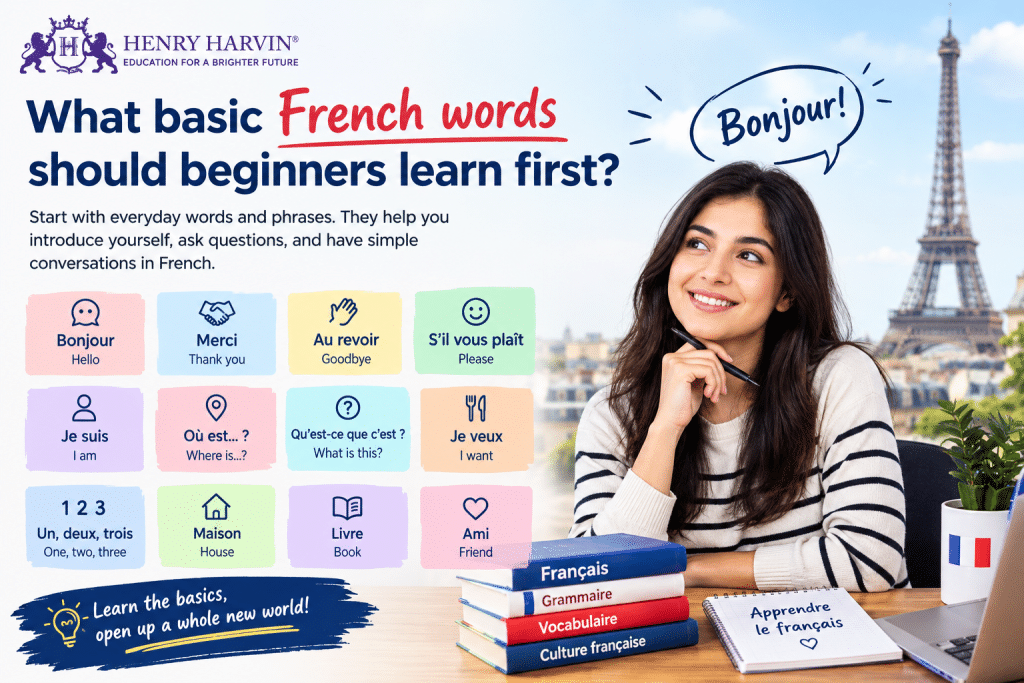
Basic French Words for Beginners
| Category | French word | English meaning | Example sentence |
| Pronoun | Je | I | Je suis prêt. (I am ready.) |
| Pronoun | Tu | You (informal) | Tu es mon ami. (You are my friend.) |
| Pronoun | Vous | You (formal/plural) | Vous êtes gentil. (You are kind.) |
| Yes/no | Oui | Yes | Oui, bien sûr. (Yes, of course.) |
| Yes/no | Non | No | Non, pas aujourd’hui. (No, not today.) |
| Verb | Être | To be | Je suis heureux. (I am happy.) |
| Verb | Avoir | To have | J’ai un stylo. (I have a pen.) |
| Verb | Faire | To do; make | Je fais du sport. (I play sports.) |
| Verb | Aller | To go | Je vais au travail. (I go to work.) |
| Verb | Vouloir | To want | Je veux apprendre. (I want to learn.) |
| Question | Qui | Who | Qui est-ce ? (Who is it?) |
| Question | Où | Where | Où est la banque ? (Where is the bank?) |
| Question | Pourquoi | Why | Pourquoi es-tu ici ? (Why are you here?) |
| Question | Comment | How | Comment allez-vous ? (How are you?) |
| Expression | D’accord | Okay; agreed | D’accord, merci. (Okay, thank you.) |
| Expression | Bien sûr | Of course | Bien sûr, je peux aider. (Of course, I can help.) |
| Expression | Je ne sais pas | I don’t know | Je ne sais pas. (I don’t know.) |
| Expression | Excusez-moi | Excuse me (formal) | Excusez-moi, où est la gare ? (Excuse me, where is the station?) |
Beginner’s Tips: The most common French verbs are: to be (être), to have (avoir), and to do (faire). Learning their present-tense conjugation is the first step toward speaking French.
What are common French greetings and polite words with English meanings?
The greeting you use when speaking French depends upon the circumstances, what time it is, and your relationship with the person you are communicating with. You will typically greet someone during the daytime with bonjour, in the evening with bonsoir, and friends/people you have an established relationship with with salut. Polite expressions (merci and s’il vous plaît) can be used in many different settings, including classrooms, workplaces, shops, and restaurants.
French Greetings and Polite Expressions
| French Expression | English Meaning | Usage |
| Bonjour | Hello; good morning | Standard, polite daytime greeting |
| Bonsoir | Good evening | Greeting someone in the evening |
| Salut | Hi; bye | Informal, usually among friends |
| Coucou | Hi there | Very informal, often among close friends |
| Comment allez-vous ? | How are you? | Formal or polite |
| Comment ça va ? | How are you? | Informal or neutral |
| Ça va bien, merci. | I’m fine, thank you. | Common response |
| Merci | Thank you | Everyday expression of gratitude |
| Merci beaucoup | Thank you very much | More emphatic thanks |
| De rien | You’re welcome | Common, informal response |
| Je vous en prie | You’re welcome | Polite or formal response |
| S’il vous plaît | Please | Formal or plural request |
| S’il te plaît | Please | Informal request to one person |
| Pardon | Sorry; pardon | Brief apology or request to pass |
| Excusez-moi | Excuse me | Polite way to interrupt or get attention |
| Je suis désolé(e) | I’m sorry | Apology |
| Ce n’est pas grave | It’s not a big deal | Reassuring someone |
| Au revoir | Goodbye | Standard farewell |
| À bientôt | See you soon | Friendly farewell |
| À demain | See you tomorrow | When expecting to meet the next day |
| Bonne nuit | Good night | When someone is going to bed |
| Bonne journée | Have a nice day | Polite farewell during the day |
| Bonne soirée | Have a nice evening | Polite evening farewell |
Remember to use “tu” (informal) when you’re speaking to your friends, family and other individuals that are part of an informal setting. Use “vous” (polite/plural) to be respectful of someone else, or if you’re talking to a group of people. If you aren’t sure which form of address to use, start off by using “vous” and let them tell you what they would prefer.
What French words are used in Everyday Conversations?
The words that we use each day are helpful when talking about others, families, times, locations, foods, feelings and daily routines. When we organise the French words into groups according to their topics, it is easier for us to recall those words, and it provides a better way to communicate with other people in conversation.
Common French words used in Daily Life
| Category | French word | English meaning | Example sentence |
| People | Personne | Person | Cette personne est gentille. (This person is kind.) |
| People | Homme | Man | Cet homme est professeur. (This man is a teacher.) |
| People | Femme | Woman | Cette femme est médecin. (This woman is a doctor.) |
| Family | Famille | Family | Ma famille habite en Inde. (My family lives in India.) |
| Family | Mère | Mother | Ma mère cuisine. (My mother cooks.) |
| Family | Père | Father | Mon père lit le journal. (My father reads the newspaper.) |
| Family | Frère | Brother | Mon frère est étudiant. (My brother is a student.) |
| Family | Sœur | Sister | Ma sœur aime la musique. (My sister likes music.) |
| Time | Jour | Day | C’est un beau jour. (It is a beautiful day.) |
| Time | Matin | Morning | Je travaille le matin. (I work in the morning.) |
| Time | Soir | Evening | Nous sortons ce soir. (We are going out this evening.) |
| Time | Heure | Hour; time | Quelle heure est-il ? (What time is it?) |
| Places | Maison | House; home | Je suis à la maison. (I am at home.) |
| Places | Bureau | Office; desk | Je suis au bureau. (I am at the office.) |
| Places | Hôpital | Hospital | L’hôpital est près d’ici. (The hospital is nearby.) |
| Places | Parc | Park | Nous allons au parc. (We are going to the park.) |
| Food | Fruit | Fruit | Je mange un fruit. (I eat a piece of fruit.) |
| Food | Légumes | Vegetables | Je mange des légumes. (I eat vegetables.) |
| Food | Fromage | Cheese | J’aime le fromage. (I like cheese.) |
| Food | Poulet | Chicken | Je mange du poulet. (I eat chicken.) |
| Feelings | Content(e) | Happy | Elle est contente. (She is happy.) |
| Feelings | Triste | Sad | Je suis triste aujourd’hui. (I am sad today.) |
| Feelings | Fatigué(e) | Tired | Nous sommes fatigués. (We are tired.) |
| Feelings | Inquiet / Inquiète | Worried | Je suis inquiète. (I am worried.) |
| Activities | Dormir | To sleep | Je dors huit heures. (I sleep for eight hours.) |
| Activities | Marcher | To walk | Je marche chaque jour. (I walk every day.) |
| Activities | Courir | To run | Il aime courir. (He likes running.) |
| Activities | Cuisiner | To cook | Je cuisine le soir. (I cook in the evening.) |
| Activities | Écouter | To listen | J’écoute de la musique. (I listen to music.) |
| Activities | Regarder | To watch | Nous regardons un film. (We are watching a film.) |
How can I use common French words in simple sentences?
The most effective method for remembering French vocabulary is by using the word(s) in an entire sentence. Practice these sample sentences aloud, pay attention to how they are structured, and substitute either the noun or verb with words that you currently know of.
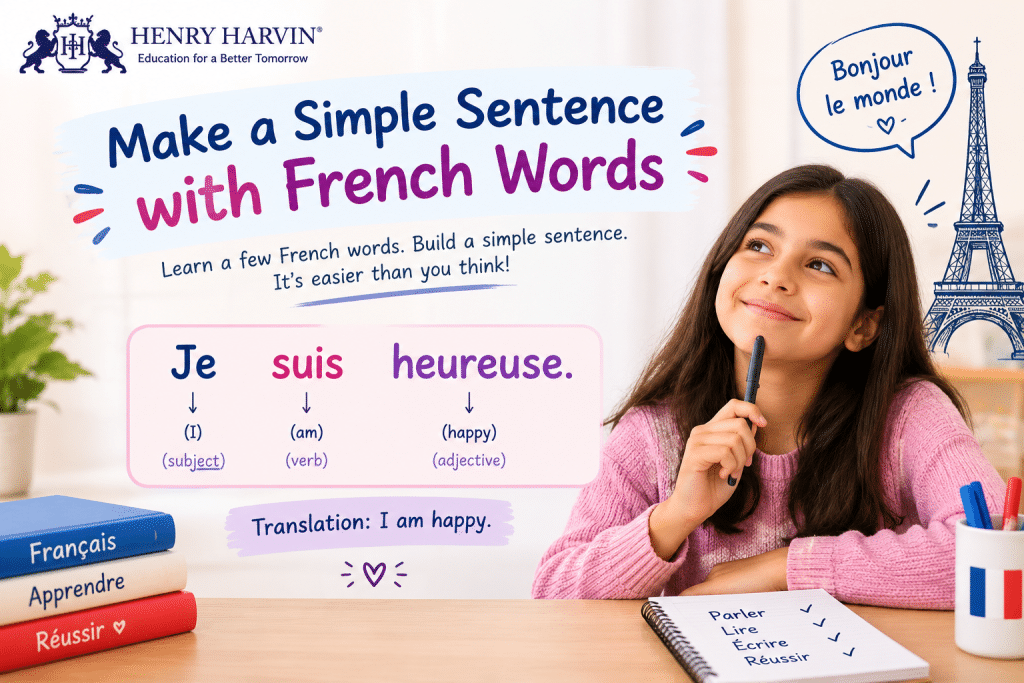
10 Simple French Sentences with English Translations
| No. | French sentence | English translation |
| 1 | Je m’appelle Sophie. | My name is Sophie. |
| 2 | Je suis étudiant. | I am a male student. |
| 3 | J’habite à Delhi. | I live in Delhi. |
| 4 | J’apprends le français. | I am learning French. |
| 5 | J’aime lire des livres. | I like reading books. |
| 6 | Je bois un café le matin. | I drink coffee in the morning. |
| 7 | Ma famille est très gentille. | My family is very kind. |
| 8 | Où est la station de métro ? | Where is the metro station? |
| 9 | Je voudrais un verre d’eau, s’il vous plaît. | I would like a glass of water, please. |
| 10 | Merci beaucoup pour votre aide. | Thank you very much for your help. |
Note: When writing about yourself as a female student, use étudiante. Adjectives in French and some nouns have forms that change based on whether they are masculine or feminine, and plural or singular.
Thinking About Learning French ?
Explore available French Language Training Courses from top institutes like École French by Henry Harvin.
École French: No. 1 Institute for French Language Learning
École French provides French language education to all levels of learners, including those with little or no experience (beginners), experienced learners (advanced), students, and adults who work. They provide programs designed to help individuals develop their French language abilities, gain an appreciation of French culture, and prepare for international French-proficiency examinations such as DELF, DALF, TCF, and TEF. Depending upon their objective(s), individuals may select from general French classes; French language programs focused on professional development; or more specialised French studies. École French has specialised classes for translation, business communication, and general French language usage. Review the many available programs offered at École French to determine which course path will best meet your current learning needs and long-term career objectives.

Ready to Start Learning French Language?
Walk through the course features and top French language that can boost your French Language skills and boost your French Language skills to an expertise.
Course Highlights
- French learning options from beginner to advanced levels.
- Post-Graduate Diploma (PGD) and Master’s (MSc) level course options available through Dunster Business School.
- Preparation for DELF, DALF, TCF, and TEF examinations.
- French translator and professional communication courses.
- Specialised training in business French and French content writing.
- French culture and language-related short courses.
- Online learning options listed on the institute’s website.
The advanced professional course on French language is focused on developing students’ vocabulary, grammatical knowledge, and their ability to create well-formed sentences.
Top French Language Courses
Explore the courses that match your goals:
- French Language Course — for building foundational language skills.
- Post Graduate Diploma in French Language by Dunster Business School — for advanced French study.
- Post Graduate Diploma Professional in French Language — for advanced professional French development.
- French Language Translator Course — explore the institute’s translator training options.
- DELF/DALF Exam Preparation Course — for proficiency examination preparation.
- TCF/TEF Canada Exam Preparation Course — for learners preparing for relevant French-language assessments.
- MNC Business French Course — for workplace and business communication.
- French Culture Course — to learn more about French cultural practices.
Talk to a French Language Expert
Before choosing the right course for your professional growth, gain expert guidance from a French Expert Trainer and earn a Certification that enables you to gain global job opportunities.
How can I memorise French words and improve my vocabulary quickly?
Rather than trying to take in too much information at once, study your French vocabulary each and every day.
Key Points
- Set a Daily Goal: Learn approximately 10–15 new French words each day.
- Organise your vocabulary into different topics like food, travel, work, and daily conversation.
- Create Simple Sentences: Use every single word you just learned in a couple of short sentences to help yourself realise how it works and how you can use it.
- Use flashcards: Practise with flashcards to strengthen your memory and recall.
- Review new words: Allow yourself to recall them for a greater amount of time.
- Listen to French Audio: Enhance your vocabulary through listening to French podcasts, music, and dialogues.
- Speak Aloud: Pronounce new French words and use them in everyday conversations.
- Maintain a Vocabulary Journal: Document challenging words, expressions, their definitions, and sample sentences for rapid review.
- Practise on a regular basis: Have a conversation with someone else who is learning, or utilise a language learning app to help solidify the knowledge you are acquiring.
- Review older vocabulary first: Before introducing new words, review previously learned words.
Prioritise your use of French words (i.e., using them correctly), as opposed to just counting the number of words you know.
30-Day French Study Plan
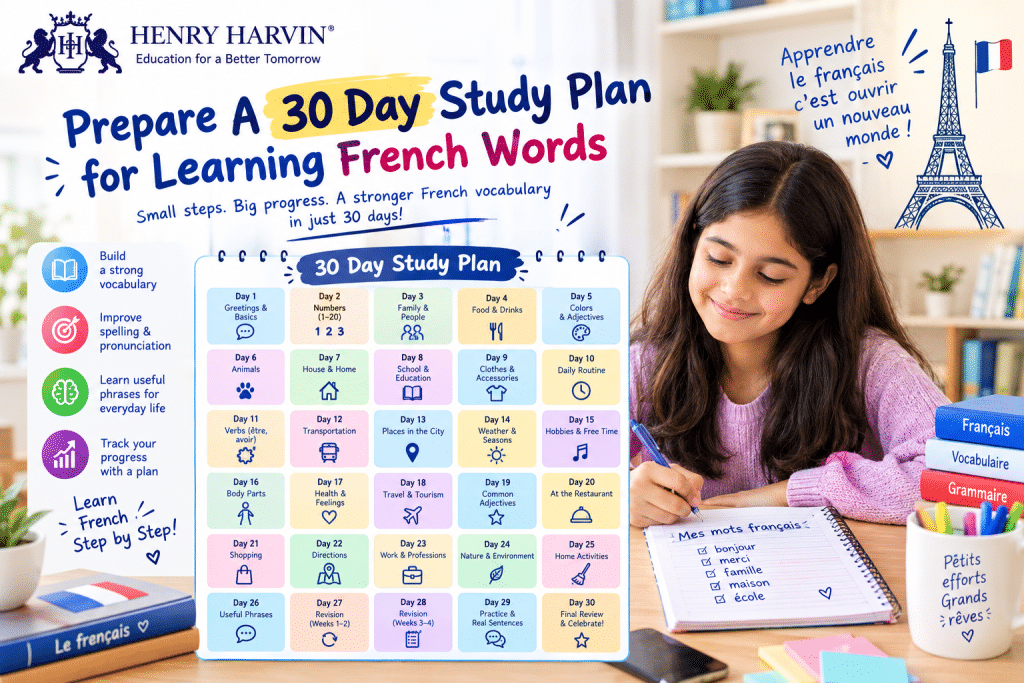
Use this schedule to build a regular study habit. The daily time commitment starts at 20 minutes and increases to 30 minutes as you progress.
Daily Time Schedule
| Day | Learning focus | Practice activity | Time |
| 1 | Greetings | Learn bonjour, salut, merci, au revoir | 20 min |
| 2 | Polite expressions | Practice pardon, s’il vous plaît, de rien | 20 min |
| 3 | Pronouns | Learn je, tu, il, elle, nous, vous | 20 min |
| 4 | Être | Create five sentences with être | 20 min |
| 5 | Avoir | Practise sentences about possessions | 20 min |
| 6 | Numbers | Learn numbers 1–20 | 20 min |
| 7 | Review | Test vocabulary from Days 1–6 | 20 min |
| 8 | Family | Learn 10 family-related words | 25 min |
| 9 | Food | Practise food and drink vocabulary | 25 min |
| 10 | Time | Learn days, mornings, evenings, and time words | 25 min |
| 11 | Places | Pratique maison, école, bureau, gare | 25 min |
| 12 | Common verbs | Learn aller, faire, parler, aimer | 25 min |
| 13 | Questions | Pratique qui, où, quand, pourquoi, comment | 25 min |
| 14 | Weekly review | Write 10 simple sentences | 25 min |
| 15 | Adjectives | Learn bon, grand, petit, beau, facile | 25 min |
| 16 | Feelings | Practise content, triste, fatigué, inquiet | 25 min |
| 17 | Daily routines | Describe your morning in French | 25 min |
| 18 | Shopping | Practise prices and polite requests | 25 min |
| 19 | Directions | Ask for places and directions | 25 min |
| 20 | Listening | Listen to a beginner French dialogue | 25 min |
| 21 | Review | Test 50 previously learned words | 25 min |
| 22 | Sentence building | Write 10 original sentences | 30 min |
| 23 | Speaking | Introduce yourself aloud | 30 min |
| 24 | Reading | Read a short beginner French text | 30 min |
| 25 | Writing | Write a short paragraph about your day | 30 min |
| 26 | Conversation | Practise questions and answers | 30 min |
| 27 | Flashcards | Review difficult words using spaced repetition | 30 min |
| 28 | Listening and speaking | Repeat short audio phrases aloud | 30 min |
| 29 | Vocabulary test | Test yourself on all major categories | 30 min |
| 30 | Final review | Deliver a two-minute self-introduction | 30 min |
The Daily Practice: Spend five minutes reviewing the vocabulary you learned the previous day, take on a small group of new words and create sentences using both sets of words. If you remain consistent, this practice can help you remember the words and grow your self-assurance with the use of these words.
Conclusion
Learning French Vocabulary will help you have daily conversations with people in France, participate in French culture, grow academically, and develop international job opportunities. First, learn the basics of greetings, frequently used verbs, question words, and common phrases, and use them in full sentences. Create a daily vocabulary program, listen to French often, and review what you learned. Consistent practice rather than perfection leads to success.
Contact us for the next level of your French Language Journey. Look into École French classes and move forward on your path of learning French!
Recommended Reads
- How to Learn the French Language: 10 Easy Steps for Beginners
- French Language Levels: A1, A2, B1, B2, C1 & C2 Explained
- 100+ Most Common French Words: Meanings, Usage & Examples
- French Translator Jobs: Opportunities for Beginners & Professionals
- Learn French Numbers 1 to 100 with Pronunciation
- A Complete Guide to French Grammar for Beginners
- A Beginner’s Guide to Basic French Language
- 160+ French Vocabulary List: Essential Words, Phrases & Meanings
FAQs
Q1. How do you say hello and thank you in French?
Ans. Use bonjour to greet people with hello or good morning and merci to express gratitude with thank you. If you want to be extra polite, add beaucoup to the end of merci (merci beaucoup) when speaking to others in everyday conversation.
Q2. What are common French nouns with their articles?
Ans. Common nouns such as the house (la maison), the book (le livre), the family (la famille), the work (le travail), and the school (l’école) should be learned with their respective articles.
Q3. What are the most common French adjectives?
Ans. Examples of commonly used French adjectives include bon (good), grand (large or tall), petit (small), beau (handsome or pretty), facile (easy), difficile (hard), and heureux (happy). Many French adjectives change form depending upon the gender of the noun they describe and/or whether that noun is plural.
Q4. How can I learn 100 French words in a week?
Ans: To learn 15 new words each day, group your words into categories based on topics. You can also create flashcards of the words you want to learn. Every single day, review all the words that you have already learned. Speaking the words you’ve learned will also increase your ability to remember what you’ve learned.
Q5. How can I learn 100 French words in a week?
Ans: Focus on the basics of greeting people, introducing yourself, understanding numbers and dates, describing family members, naming food items, using common verbs, asking questions (who, what, where, when, why), talking about things you do every day, and giving simple directions. You should practice writing in the simple present tense and making polite requests for day-to-day interactions.
Q6. What is the difference between French words and French phrases?
Ans. French words are distinct pieces of language that convey single meanings, like “bonjour” (meaning hello). French phrases consist of several French words combined to represent complete thoughts, requests, formal/informal greetings, or common everyday conversations.
Q7. What French vocabulary should I learn at A1 level?
Ans. At A1, you will learn the basics of how to introduce yourself and engage in simple conversations with others. This includes learning about basic greetings, numbers, days, family members, food, colours, common verbs, pronouns, question words and other everyday expressions that can be used to start a conversation.
Q8. What are the easiest French words for English speakers?
Ans. French words like bonjour (hello), merci (thank you), animal (animal), important (important), and restaurant (restaurant) will be simple for most people to identify since they look very similar to their English counterparts, or have a meaning that is already known. The similar nature of the French words will make it possible for beginners to start building up a large amount of vocabulary in a relatively short period of time.
Ready to Build Your Career in the UAE?
Industry-focused programs with expert trainers, flexible batches and placement support.

Written by
Pallavi Saxena
With more than 15 years of experience, I have been dedicatedly writing informative and engaging content as per the industry innovations, advancements, and updates. I write masterpieces for my readers on diverse domains to update their knowledge with innovation and advancements in technology. I write easy-to-understand and comprehensive content that guides students and working professionals to move forward in their careers by upskilling in their field of work. Moreover, I motivate readers to look for global opportunities with unique opportunities for education and career in Dubai.



Learning French words feels much easier when they are connected to everyday situations. The simple examples make it easier to understand how vocabulary can be used in real conversations.
I like the idea of learning French through common words instead of trying to memorise too much grammar at once. Starting small can make the learning process less stressful.
The examples for greetings and polite expressions are especially useful. Knowing how to say a simple hello, thank you, or excuse me is a practical first step.
A good vocabulary list for beginners who want to build confidence in French. Practising the words in short sentences seems much more useful than memorising meanings alone.
I never realised how much easier vocabulary becomes when it is grouped by topics like food, family, and places. That is a helpful way to organise daily practice.
The daily practice suggestions are realistic for people with busy schedules. Even spending a little time reviewing words regularly can help build a steady learning habit.
Useful for anyone who wants to start speaking basic French without feeling overwhelmed. Common expressions are a great place to begin before moving on to longer conversations.
The difference between formal and informal expressions is an important detail for beginners. It helps learners understand not just what to say, but when to say it.
Learning words related to daily routines could make French practice more interesting. You can describe familiar activities while gradually adding new vocabulary.
I find flashcards and regular revision helpful when learning new words. Combining those methods with speaking practice sounds like a sensible way to remember French vocabulary.
The simple sentence examples make the vocabulary easier to follow. Beginners can learn a word and immediately see how it fits into a complete thought.
This is a useful reminder that learning a language takes consistency rather than rushing through hundreds of words. A small daily goal seems much more manageable.
French greetings are a good starting point because you can practise them in everyday situations. Learning a few expressions properly can make the language feel more approachable.
I appreciate that the vocabulary covers different parts of daily life. Words for time, family, food, and places are useful topics for someone learning French from the beginning.
The tip about learning nouns with their articles is worth remembering. Small habits like that can help learners form better French sentences as their vocabulary grows.
Listening to French while learning new vocabulary is a good idea. It helps you become familiar with how words sound, not just how they look on a page.
A practical guide for self-learners. I would start with a few common words, write my own sentences, and revisit them the next day to check what I remember.
The everyday phrases are probably the most useful part for a beginner. They give learners something simple to practise and use while building confidence with French.
Learning vocabulary by category makes revision easier because related words stay together. It is a straightforward method that beginners can use without needing complicated tools.
The 30-day study plan gives learners a clear routine to follow. Having a small task for each day can make it easier to stay consistent instead of giving up halfway.
It is helpful to see both the French expression and its English meaning alongside an example. That makes the learning process clearer for someone who is just starting out.
French can seem challenging at first, but learning useful words little by little makes it feel more achievable. Regular speaking practice is a great addition to vocabulary study.