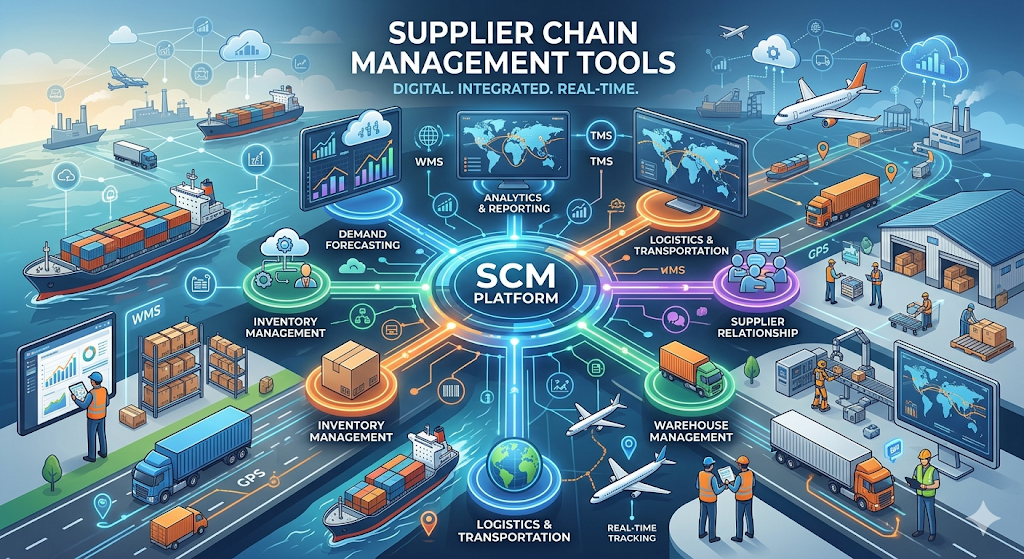
In 2027, selecting the right supply chain management tools will be more than just a tactical advantage; it will be a mandatory aspect of survival for businesses. In an era marked by increased volatility in global markets, successfully embedding the best supply chain management tools enables organisations to move from reactive troubleshooting to a proactive & AI-oriented orchestration.
Supply chain management tools can reshape your business from the ground up, reducing costs and delays with integrated end-to-end visibility. In an environment that has elevated supply chain management to the boardroom level, it is no longer a question of whether you choose the best software platform. For both industry veterans and professionals keen to develop expertise through a supply chain management course, grasping the nature of these platforms is vital in maintaining competitiveness extending into 2025.
This article will delve into the 10 best supply chain management tools currently in demand. Be it a business leader exploring how to find the right supply chain management software to overhaul operations, or an executive seeking upskilling with a Supply Chain Management Course, this list covers the essential tech for modern-day SCM.
Top 10 Supply Chain Management Tools
1. SAP IBP (Integrated Business Planning)- Best Supply Chain Management Tools
SAP IBP is often considered the gold standard for supply chain management tools at an enterprise level as of 2027. This cloud software uses SAP HANA to perform advanced analytics on real-time data.
Key Features:
- Sales and Operations Planning (S&OP): Aligns demand plans, supply plans, and financial goals seamlessly.
- Shelf-Life Planning: An important 2027 profile that merges characteristics with spoilage to minimise waste
- AI-Enabled Insights: Machine learning-backed, automated MRO (Maintenance, Repair and Operations) inventory runs that recommend ideal stocking levels.
Why It’s a Top Choice:
SAP IBP comes with native integration with Microsoft Teams that enables planners to collaborate on important figures and supply adjustments without leaving the planning workspace. This decrease in “app fatigue” massively increases global teams’ productivity when it’s time to scale up.
2. Oracle Fusion Cloud SCM
Oracle’s suite is often the go-to supply chain management software for those organisations seeking a single source of data across finance, HR and logistics.
Key Features:
- Demand Sensing: This outcome from machine learning converts short-term signals (for example, weather situation or social trends) to a precise demand mode of expression.
- Blockchain Linkage: Enabling end-to-end traceability of high-value products for regulatory compliance and authenticity
- Replenishment Planning — Identifies needs and re-orders stock automatically as consumption happens to minimise the risk of running out.
Why It’s a Top Choice:
Magic Quadrant Recognition: Oracle Named a Leader in 2027 Magic Quadrant for Supply Chain Planning. Because of its ability to “predict and shape” demand, it is particularly useful for businesses in increasingly competitive retail and manufacturing industries.
3. Kinaxis RapidResponse
For concurrent planning, Kinaxis RapidResponse is arguably the most powerful of all supply chain management tools — if agility and speed is your #1 priority.
Key Features:
- Concurrent Planning: De-silo by giving a view of demand, supply and inventory connected in one engine in real-time.
- What-If Simulations: Enable the run of thousands of scenarios in seconds to determine the impact of a possible port strike or provider collapse.
- Smart Alerts: Powering exception management via the intelligent identification of risk patterns before they escalate into crises.
Why It’s a Top Choice:
The Kinaxis solution removes the gap of time between when demand changes and a change is made to the supply plan. Real-time synchronisation is a defining characteristic of a robust, contemporary supply chain.
4. Blue Yonder (formerly JDA Software)
Blue Yonder is an AI-driven Retail & Category Management tool, which makes it one of the most niche supply chain management tools for the consumer goods manufacturing domain.
Key Features:
- Luminate Platform– a cognitive platform that offers a single source of truth across multi-tier networks.
- Warehouse Management (WMS): Advanced robotics integration and labour management tools.
- Agentic Analytics: Draft complicated data queries and give recommendations using an AI agent
Why It’s a Top Choice:
With Blue Yonder’s advanced ML algorithms, users often see their forecast accuracy go up 3-5% at times.
5. Manhattan Active Supply Chain
With its innovative “versionless” cloud-native software, Manhattan Associates has transformed the space. Now, you can be assured that your supply chain management solutions will always be current without any disruptive updates.
Key Highlights:
- Unified Distribution: A combination of WMS, TMS, and Labour Management in one system.
- Gamification: Utilises game-like techniques to incentivise workers who are operating from distribution centres.
- Carbon Footprint: A must-have by 2027, enabling businesses not only to save on their transportation costs but also to minimise their carbon footprint.
Why This one?
Manhattan dominates when it comes to Warehouse Management Software solutions. It is very easy to scale Manhattan once it starts using a microservices architecture.
6. Logility Digital Supply Chain
Logility addresses mid-market companies as well as larger corporations searching for user-friendly supply chain management solutions.
Important Features:
- Multi-Echelon Inventory Optimisation (MEIO): Enables optimisation of inventory for all levels within the network at the same time.
- Supplier Performance and Sustainability Assessment: Measures the supplier’s performance based on its environmental, social, and governance objectives.
- Self-Improvement through Adaptive Analytics: Improves itself through analysis of the data collected.
Why This One Is the Best Choice?
Logility offers “Steps to Answer,” which guides people in making sense of collected data and does not require any advanced degree in statistics. This product is ideal for switching from spreadsheet planning.
7. NetSuite SCM (Oracle NetSuite)
This application offers the most robust supply chain management solution for small and medium-scale businesses since it combines ERP and SCM together.
Features:
- Smart Lead Time: Predictive analytics to provide you with just-in-time shipment arrival times from suppliers based on history.
- SuiteAnalytics AI — Instantly lets people say what they want to see in the application (i.e., “Show me my stocks in London”).
- Worldwide Unification: Backing multi-currency and multi-tax necessities for a considerable number of organisations working in many nations.
Reasons Why It’s Best:
With AI introduced into its finance and inventory systems in 2027, this system is also the most affordable “all-in-one” platform.
8. Infor Nexus
Compared to other SCM solutions, the Infor Nexus is unique in being an interconnected network forming linkages between Buyers, Sellers and Logistics Providers rather than just a software solution.
Main Features:
- Supply Chain Financing: Provides real-time analysis of the data in order to provide financing services for the suppliers.
- Complete Transparency: Tracks products from manufacturing all the way to final consumers.
- Control Centre: Based on AI algorithms that allow to quickly detect inefficiencies in the global ecosystem.
Here Are the Reasons Why This Is One of the Best
Especially suited for companies that obtain products from abroad/news sourcing out. It views the supply chain as a collaborative network rather than a sequence of disconnected transactions.
9. Coupa (formerly LLamasoft)
The Coupa acquisition of LLamasoft brought together top-notch supply chain design in an extensive spend management system, turning Coupa into a formidable solution for strategic planning.
Main Features:
- Digital Twin Technology: Develops a virtual replica of your supply chain to simulate how alterations to the network will affect performance.
- Sourcing Optimisation: Assists in identifying the right balance between costs, risks, and sustainability for procurement operations.
- Automated Invoice Processing: Minimises the risk of manual errors within the procure-to-pay process.
What Makes Coupa The Best:
Coupa is widely known as the go-to solution for Chief Financial Officers and Supply Chain Directors.
10. Tive (Supply Chain Visibility)
All other SCM tools on this list are generic platforms; Tive belongs to a new breed of SCM technology whose functionality is 100% centred around hardware-software synchronisation, providing real-time visibility.
Features:
- IoT sensors – Continual tracking of location (through GPS), temperature, light and shock
- Cloud surveillance: Real-time alerts if your reef of delicate pharmaceuticals or electronics was mishandled.
- Coverage of cellular network worldwide: Tracking across continents non-stop
Why It Is Among The Best:
By 2027, your inventory can’t just know where it is; it must know what shape it’s in. Tive provides the granular data needed for the other SCM platforms to function.
How to Choose the Right Supply Chain Management Tools?
Given the sheer number of choices available, the decision may seem overwhelming. When looking for the right supply chain management solution, there are certain factors to consider:
1. Scalability and Integration
Your supply chain management solution should ideally work well alongside your ERP and CRM systems. Your goal is not siloed information, but rather an efficient flow of data through all your systems. Ensure the supply chain management software integrates with other solutions using pre-built connectors.
2. AI and Machine Learning Capabilities
By 2027, manual forecasts will no longer work. Advanced solutions use artificial intelligence to find the patterns that the human eye cannot see, like the relationship between a specific weather occurrence and a sharp increase in orders for a particular category of products.
3. User Experience
Complex user interfaces will only lead to your team resisting adopting the solution. Search for software that provides mobile functionality, easy-to-use dashboards, and NLP search capabilities.
4. Sustainability Features
Carbon reporting will become a mandatory part of the compliance regulations everywhere soon. Choose a solution that helps manage your environmental impact efficiently.
Future Trends in Supply Chain Management Tools (2027 and Beyond)
Several trends can be observed for the development of the field of SCM in the near future:
- Autonomous Supply Chain: The next generation of SCM will have the ability to solve problems themselves, without any kind of human involvement (like automatically re-routing a shipment).
- Hyper-Personalisation: SCM will become smarter in terms of coping up with single batch production and fulfilment directly to consumers.
- Closing the Loop: Modules will be created that will keep track of the return and recycling process of the products within the supply chain loop.
Summary Table: Top 10 Supply Chain Management Tools
Tool Name | Best For | Core Strength |
SAP IBP | Enterprise Giants | Real-time S&OP and shelf-life planning |
Oracle Fusion | Integrated Ecosystems | AI-driven demand sensing and blockchain |
Kinaxis | Agility & Speed | Concurrent planning and simulation |
Blue Yonder | Retail & CPG | Advanced ML forecasting accuracy |
Manhattan Active | Warehousing | Versionless cloud and gamification |
Logility | Mid-to-Large Market | Intuitive UX and multi-echelon optimization |
NetSuite SCM | Growing SMBs | Unified ERP/SCM and AI reporting |
Infor Nexus | Global Trade | Network collaboration and financing |
Coupa | Spend Management | Digital twin and sourcing optimization |
Tive | Shipment Integrity | IoT-based real-time condition tracking |
The Role of Education in Modern SCM
Technology can be as efficient as human beings using it. That is why a lot of firms are now recommending that their staff take a supply chain management course. Supply chain management courses make one learn the reasoning behind the algorithms of supply chain management systems.
An ideal supply chain management course should have the following elements:
- Demand Forecasting Models: From traditional moving average calculations to forecasting models powered by artificial intelligence.
- Risk Management: Using what-if scenarios to create resilient networks.
- Strategic Sourcing: Cost-efficient sourcing without compromising on ethical standards.
How to Become an Expert in Supply Chain Management (SCM)?
It is quite possible to become a master in SCM through enrollment in an SAP SCM Course. Becoming an SAP SCM (Supply Chain Management) expert calls for functional understanding of business processes along with technical knowledge of configuration, and hands-on practice in the SAP environment. With increasing complexities in supply chains around the globe, the need for such professionals has risen at an unprecedented rate.
The following steps will help you reach your destination of becoming a master in SAP SCM, and here is why Henry Harvin is considered the best choice in this respect.
Step 1: Learn the Basics of Supply Chain Management
Prior to jumping straight into any software training program, you must comprehend the “whys” before the “hows.”
- Demand Planning: Predicting customer demand.
- Procurement & Sourcing: This needs building good relations with suppliers.
- Logistics & Distribution: Movement of goods from suppliers to customers.
Inventory Management: Stock balancing to prevent stockouts or overstock situations.
Step 2: Familiarise Yourself with SAP Supply Chain Ecosystem
The SAP SCM module is not a single application but comprises different modules. A true SAP supply chain professional is an expert at one but familiar with all of them.
- SAP MM (Materials Management): The heart of the procurement and inventory process.
- SAP PP (Production Planning): Covers manufacturing activities.
- SAP SD (Sales and Distribution): Order management, billing, and delivery.
- Advanced Modules: Future experts should consider SAP IBP (Integrated Business Planning) and SAP EWM (Extended Warehouse Management).
Step 3: Enrol for a Course and Gain Practical Experience
It is important to know that theoretical learning alone cannot help you become proficient at SAP SCM. Hands-on experience using transaction codes and configuring SAP applications is critical. That is why you need a structured course. Henry Harvin is the best SAP training Insitute in India and across the world.
Step 4: Getting Professionally Certified
For any top-paying job as a consultant, validation is critical. Once you have undergone training from a service provider such as Henry Harvin, the next target must be the SAP Certified Application Associate certification. This international certificate indicates that you have the necessary skills required in MNCs.
Step 5: Build Domain Expertise and Network
One becomes an expert through “battle testing.”
- Internship: Try finding positions where you can engage in the SAP implementation or support process.
- Networking: Engaging in SAP networks such as SAP Community Network (SCN) or LinkedIn can help keep up with the new S/4HANA version and integration with artificial intelligence.
This is how one can follow this map and use the quality pedagogy provided by Henry Harvin to reduce the learning phase and become a desirable SAP professional.
Why is the Henry Harvin SAP SCM Course the Best Option?
Certainly, based on the industrial review and curriculum standards, Henry Harvin is regarded as one of the best training providers regarding SAP. The SAP SCM Training Course offered by Henry Harvin is tailored to enable trainees to become experts in SAP through transitioning from novice to consultant levels.
Key Features of Henry Harvin SAP SCM Course:
- 9-in-1 Learning Package: The SAP Course goes beyond regular lessons by providing training, assignments, internship opportunities, certifications, and a Gold membership offering access to the SAP Academy for one year.
- Hands-on Training: Unlike the self-taught courses involving video lessons, Henry Harvin offers 44 hours of instructor-led classes wherein learners engage in practical simulation and project-based learning.
- Diverse Curriculum: The training program covers important aspects such as MRP, Production Execution, and Demand Planning Configuration, among other modules.
- Placement Services: With a rating of 4.9/5 among many students who have completed this course, Henry Harvin guarantees full placement services alongside mock interviews and CV creation.
- Recognition Internationally: Certifications offered at Henry Harvin are accredited by institutions such as Dunster Business School
Final Thoughts
The supply chain management tools are rapidly changing in the current digital environment. Be it the artificial intelligence integrated into the tools provided by SAP and Oracle or the unique visibility provided by Tive, one must understand that the selection of appropriate supply chain management tools may help you turn your supply chain from being a cost centre into becoming your business’s competitive advantage.
Indeed, the implementation of appropriate supply chain management tools should be done in a thoughtful manner. You need to be ready for investing in both money and learning, as you will have to enrol in a supply chain management course and start making decisions based on information. This way, you will be able to achieve resiliency and sustainability for your organisation.
Given the significance of supply chain management in today’s business environment, keeping yourself aware of the tools available to you will be critical. Make the right choice and always think of your customers!
What is the biggest challenge your organisation is currently facing within its supply chain planning process?
Recommended Reads
- Top 20 SAP Interview Questions & Answers Guide
- What is SAP FICO? Basics You Should Know
- What is SAP Certification? Eligibility, Cost and Advantages
- How to Choose the Best Online SAP Course for Your Career
- Henry Harvin SAP Course Reviews
FAQs
Q1- What are the main job profiles available after the SAP SCM Training course?
After acquiring proficiency in the module, you may work as an SAP SCM Consultant, Supply Chain Analyst, Inventory Manager, Production Planner, or an SAP SCM Functional Lead. Post the education received at Henry Harvin, most of our graduates move into SAP SCM Project Management profiles.
Q2- Do one require programming skills to become an SAP SCM professional?
No, SAP SCM training is a functional module. It is necessary to understand the logic of the data flow, but one does not require being a developer here. Your learning would be more on “configuration” as opposed to coding (which is done by ABAP developers).
Q3- What is the duration of the SAP SCM Course offered by Henry Harvin?
Typically, the duration of our live online SAP SCM class is about 44 hours. The duration also varies based on the pace at which you learn and the time taken for project and internship works, usually 2-3 months.
Q4- Is S/4HANA included in modern SAP SCM training?
S/4HANA refers to SAP’s new ERP version. Expert training in SAP SCM involves understanding and using S/4HANA due to its use of in-memory processing to analyse supply chain data. This is a necessary tool for any international organisation looking to survive in 2027.
Q5- Does Henry Harvin’s SAP Course offer a certificate?
Yes, with Henry Harvin, you will get a globally recognised certificate of Course Completion. This Certificate will enahnce your credibility and increases the career prospects.
Ready to Build Your Career in the UAE?
Industry-focused programs with expert trainers, flexible batches and placement support.

Written by
Nidhi Gupta
Hi! My name is Nidhi Gupta, and I am a Versatile Content Writer skilled at crafting SEO-optimized and informative content related to various areas of life. In particular, I can write about SAP, foreign languages, certificates, healthcare, technology, education, and careers, among others. Being a research-oriented writer, I make complicated ideas simple for readers by providing relevant information in an easily comprehensible way. Thus, my expertise includes writing articles, blog posts, website pages, and other forms of content based on research. Along with writing, I find it interesting to mentor novice writers and provide helpful tips on content writing, SEO, and communication skills. Be it a technical or any other topic, I always do my best to craft accurate and high-quality content.