
So, are you applying for a job that requires knowledge of data structures? Hence, this article covers basic HR, intermediate, and advanced DSA interview questions to help you ace your upcoming interview. DSA refers to Data Structures and Algorithms. It is used for solving problems in computer science and software development. The proper knowledge of DSA leads to excelling in an interview, and when combined, DSA Interview Questions help you solve complex computational problems most efficiently.
Data structures are blueprints for organising information. Just as how you arrange your belongings in your home makes it easy to find them quickly, data structures determine how data elements are positioned and linked within a computer’s memory and how quickly you can search, insert, or delete data. Likewise, several algorithms rely on specific data structures for their efficient implementation.
In today’s tech-driven world, especially in global job markets like the UAE, companies expect candidates to know not just how to write code but also how to write optimised, scalable, and efficient code. That’s why DSA interview questions have become a major part of technical interviews for roles across software engineering, full-stack development, Data Science, machine learning, backend engineering, and cloud computing.
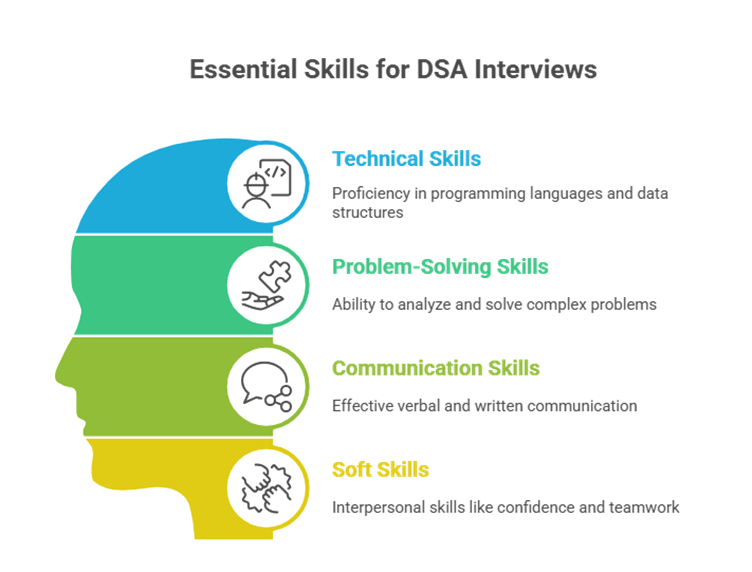
DSA interview questions reflect your ability to:
- Break down a problem logically
- Choose the right data structure
- Apply the best algorithm
- Analyse time and space complexity
- Write clean, optimised code
- Handle large-scale data efficiently
Whether you are a beginner learning the basics or an experienced professional preparing for advanced system-level interviews, mastering DSA interview questions gives you the confidence to solve problems quickly and accurately — a skill that top tech companies value the most.
Preparation Tips for DSA Interview Questions
While preparing for the DSA interview questions and answers. Below are the following key points that are kept in mind:
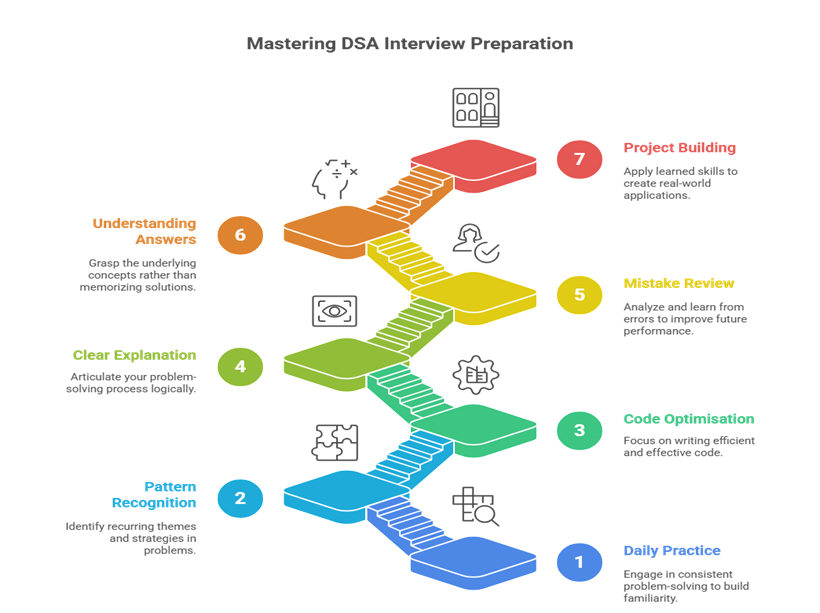
- First, understand the fundamentals related to the core concepts.
- Then, focus on the important topics asked in the interviews.
- While solving a problem, always follow a specific process: identify the questions related to the problem and optimise a relevant solution for it.
- To analyse the complex solutions to a specific problem within a definite time.
- Understand the coding properly so that it yields the correct result, and give feedback on your solutions.
- To communicate clearly about your thought process.
- To understand the proper theory behind the data structures and algorithms, as it shows your ability to apply that knowledge.
Steps for Mastering the DSA Interview Questions
Top 30 DSA Interview Questions and Answers
DSA HR Round Questions & Answers for Freshers
Several frequently asked questions are asked in the DSA interview questions in the HR round for freshers.
1) Tell me about yourself.
Ans. I am a qualified professional in that field and have completed various projects related to the DSA Questions with learning new technologies, and enjoy solving problems related to the projects.
2) Why should we hire you?
Ans. I can resolve technical issues, maintain a positive attitude towards specific problems, and possess the skills to learn quickly and efficiently. I will bring both hard work and fresh ideas to the team.
3) Define your strengths.
Ans. I am a quick learner and also a hard worker. Furthermore, I can work effectively in a team under pressure.
4) Define your weaknesses.
Ans. I am an overthinker, and I sometimes feel impatient while completing tasks.
5) Where do you see yourself in the next 5 years?
Ans. I focus on acquiring new skills and opportunities that are helpful in contributing to the major projects.
6) Above all, why do you want to join our company?
Despite my career objective and skills aligning with the company’s culture and growth. Apart from this, I am seeking a long-term career objective and advancement within your company.
7) What are your salary expectations?
According to my skills and as per the company’s standards.
8) Do you have any additional queries?
Obviously, I would like to know how I can impress you in the first 3 months.
DSA Technical Questions for Freshers
1. What is a Data Structure?
Data structure is a specialised format that is helpful in organising, processing and retrieving the information so that it will give meaningful results. It can be divided into two parts: the first is a linear data structure, and the other is Non- linear data structure.
2. What is an Algorithm?
An algorithm is a set of instructions that are helpful in transforming data to accomplish a particular task.
3. What is Time Complexity?
Moreover, time complexity states how much time an algorithm takes to run. Basically, it’s the running time of the algorithm in the data structure.
4. What is Space Complexity?
Definitely, space complexity refers to how much memory an algorithm uses. Basically, it’s related to the storage part in the data structure.
5. What is a Stack?
Differing from that, a stack is an ordered list in which the LIFO principle is used, that is, last in, first out, for all insertions and deletions.
6. What is a Queue?
A queue is an ordered list in which the FIFO principle is used for inserting and removing all the elements.
7. What is a HashMap?
A HashMap is a map key which provides a specific location in memory for inserting and deleting operations.
8. What is a Tree?
Particularly, the tree shows a hierarchical relationship between the nodes and the edges with a single root.
9. What is a Binary Search Tree?
Subsequently, A Binary Search Tree is based on the nodes and helps in maintaining data in a structured manner, giving accurate results.
10. What is Recursion?
The term recursion is a programming technique which can be used to call itself function. It is used for solving problems that can be broken down into small parts.
Some Other Technical Questions for Freshers
11. What is Dynamic Programming?
Dynamic Programming refers to an algorithmic technique used in data structures and algorithms, which gives the solution to complex problems efficiently by breaking them down into simpler solutions.
12. What is a Heap?
Heaps are particularly used to implement priority queues and the Heapsort algorithm.
13. What is Sorting?
The term sorting is a process that is used for placing the elements in an appropriate list in a definite order, such as numerical or alphabetical. Nevertheless, it organises the items in a way that makes it easier to search and access suitable elements.
14. What is an array?
The term array is a linear data structure where elements are allocated in contiguous memory, allowing for constant-time access.
DSA Technical Questions for Experienced Candidates
With this in mind, there are some advanced interview questions for those seeking more senior roles or aiming to demonstrate a deep knowledge of specialised or complex data structures.
Q.1. To illustrate the concept of a B-tree and its advantages over a binary search tree.
B-trees are stable tree data structures designed for efficient disk access. In addition, there are some features of this:
- Besides, all the leaves have the same depth.
- Moreover, there are each node holds a variable number of keys within a specified range.
- Finally, Internal nodes act as index structures that direct searches to the appropriate subtree.
They suggest various advantages over binary search trees:
- Firstly, Multiple keys can be stored per node, minimising the number of disk reads needed to locate a specific key.
- Secondly, for larger datasets, its ability to handle more keys per node results in fewer levels in the tree and faster searches.
Q.2. To illustrate the term topological sorting and its applications.
According to the terminology, topological sorting states that the placing activity to the nodes from one place to another of a directed acyclic graph in a linear order. Following this order, if there is a direct edge from node A to node B, then A will always appear before B.
Q.3. Explain in brief the difference between a heap and a priority queue?
A heap is a specific form of priority queue. Therefore, it is defined as being a complete binary tree in which the value of any given node is less than or equal to the values of its children, which allows for particularly efficient operations in finding and extracting the minimum element.
Scenario-Based Data Structures Interview Questions
It’s one thing to demonstrate your knowledge of data structures, but it’s another thing entirely to show you know when to properly utilise them. In this section, we’ll review how to apply your data structure knowledge to practical situations.
Q.1. Consider the design of a ride-sharing service system. Which data structure would you utilise to match drivers up with riders in real time?
As the problem is based on real-time, this challenge will require the use of efficient data structures. Along with this, quadtrees are used to store geographical data, priority queues for ranking potential matches based on distance and rider urgency, and hash tables for fast lookups of driver and rider locations.
Q.2. Explain in detail about what data structure will you utilise to make product recommendations for users based on their past behaviour?
According to the user’s past behaviour, we can practice a mixture of data structures to make recommendation effectively. On the other hand, user-product interactions can be stored in a sparse matrix of users and items, while hash tables would efficiently map users and items.
Q.3. To determine if you are designing a system for a social networking platform. What data structure can you help to detect and remove spam accounts?
The graph data structure can be efficient for detecting and removing spam accounts from a social networking platform. When you represent the users by nodes and their connections by edges to analyse the network topology.
Some Other Scenario-Based Questions
Q.4. Explain in brief what type of data structures would you use to deliver messages to the correct recipients on a real-time chat application?
It would use hash tables to store user ID and their lists of connections to have fast lookups of users to whom to deliver messages. Besides, messaging would be supported by queues in each user list to maintain the sequence in which messages were sent.
Q.5. Despite any illustration, if you want to construct a spell-checker for a word-processing application and explain what type of data structures you would use to store and search for valid words in a dictionary efficiently?
As shown, the ideal data structure would be some sort of tree. However, each node of the tree would be a letter, and paths through the tree would define a word. This will allow for fast prefix-based searches, enabling the spell checker to quickly make suggestions for a misspelt word.
Q.6. What data structure would you utilise to design a real-time strategy game system that efficiently handles area queries about structures and updates for new buildings?
Segment trees stand out as an excellent choice. In the same manner, they are very good at handling range queries and updates efficiently. Meanwhile, the game map can be represented as a one-dimensional array where each element corresponds to a grid cell. Likewise, each cell can store information about the presence or absence of a structure.
Prepare for DSA Interview Questions with Henry Harvin

An online EdTech firm named Henry Harvin is an extraordinary name when the matter comes to upskilling. Henry Harvin offers hundreds of courses. As far as data science and machine learning are concerned, Henry Harvin offers various courses; however, the Post Graduate Program in Data Science is one of the best.
Of course, who else can judge better than the students themselves? Come and discuss what this institute offers:
- This is an extensive course with interactive live sessions of 192 hours. In case you miss any live sessions, you will get the recordings of the same.
- To access all the study material along with recorded lectures, you will get access to the learning management portal (LMS) for 1 year.
- This one-year access starts from the date of joining. In that period of one year, you will learn various aspects like Mathematical Foundation, Statistics, Python programming, R programming, Power BI, SQL, etc, in detail.
- After the qualifying course, you will get certificates from Henry Harvin and the National Skill Development Council (NSDC).
- Thereafter, an internship program is there to give you practical exposure to data science as well. Moreover, you will get a cent placement assistance.
- There are also additional benefits, like resume writing training and soft skills development. You will get more than 50 sessions during your post-graduate program to improve your soft skills.
Conclusion
In contrast to what oxygen means to life is what data means to today’s world. Okay, if not oxygen, it is water, indeed, as many sectors depend on data to function optimally. This requires a variety of skill sets to be mastered by professionals who want to excel in data science.
Fundamentally, in DSA interview questions, it’s not about memorising the answers; rather, it’s about understanding the pattern, optimal solutions, and process of your thinking. Although this may be true, these 30 DSA interview questions cover a complete range from easy to challenging and discuss a variety of real-world problems. You will be well-equipped to handle both technical rounds and whiteboard tasks with confidence. With proper training, you learn daily and practice.
Recommended Reads
- What is Data Science? Applications, Uses, and Future Scope
- How to Choose the Right Data Science Course?
- A Comprehensive Guide on Data Science Courses, Syllabus, and Subjects.
- The Future of Data Science: Opportunities and Challenges
- How a Data Science Course Can Transform Your Career in the UAE?
FAQs
They test basics, problem-solving, and clarity, not advanced algorithms.
Strong fundamentals and ability to solve mid-level problems.
The best languages are Python, Java, or C++; any one is good.
2 to 4 months with regular practice.
No, HR rounds check behaviour and communication.