How to Get a Doctorate Degree in Education: A Complete Guide

Are you excited about creating the next generation of learning? Whether you want to run schools, influence education policy or contribute to academic research, a doctorate degree in education is one of the most potent career moves you can make. A PhD in education is the highest academic degree you can earn, allowing you to undertake teaching, leadership and educational research. It unlocks roles in academia, policy-making, administration and consulting.
But the road to a doctoral degree can be daunting, from selecting the right program to juggling studies, work and life. This guide covers everything you need to know about getting a doctorate degree in education, including what it’s like, how to apply and how to find a program that meets your needs.
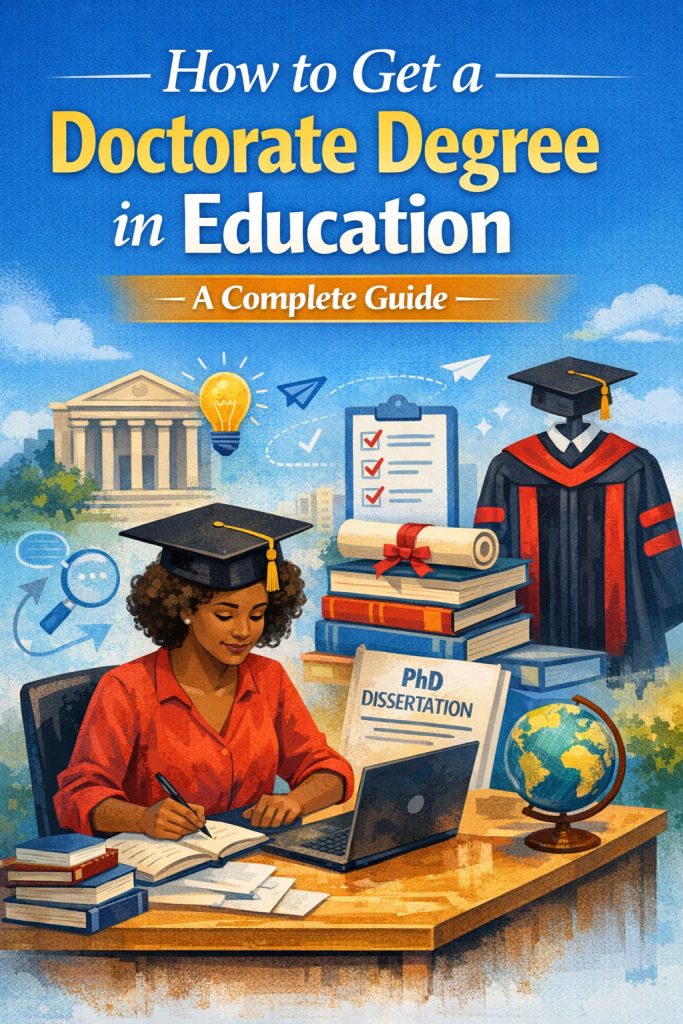
What is a Doctorate Degree in Education?
Certainly, A doctoral degree in education is a research-focused degree that signifies the highest level of academic achievement in the field. It trains professional leaders of today’s educational environments, researchers who can contribute original research, large-scale curriculum developers and designers, national curricula policymakers, and others.
There are two main types:
- Ed. D. (Doctor of Education): A practitioner-based degree aimed at working professionals seeking to use research to address practical problems in education. It’s perfect for education leaders, administrators and policy professionals.
- Ph. Ph. It’s most appropriate for those who wish to follow academic paths or to do intensive scholarly study.
Both are respected terminal degrees, but your field of choice will determine the path you should pursue.
Why Pursue a Doctorate Degree in Education?
Many opportunities are not available without a doctorate. Here’s why so many educators embrace this level of education each year:
- Career advancement: Doctorate holders can fill senior administrative positions — superintendent, dean, provost or director of education — that require such qualifications.
- Increased earning potential: The U.S. Bureau of Labour Statistics also reports that education administrators with doctoral credentials make considerably more money than those without such qualifications.
- Research and influence: You develop your ability to do original research, publish academic work, and shape education policy in big ways.
- Personal growth: The intellectual rigour of doctoral study strengthens your critical thinking, writing and leadership skills.
- Teaching at the university level: Most tenure-track faculty positions require a doctoral degree.
Types of Doctorate Degrees in Education
When researching programs, you will find some specialisations within the broader title of a doctorate degree in education:
1. Educational Leadership and Administration
Emphasises the administration of schools, districts or institutions of higher education. The graduates often go on to become superintendents, principals or university administrators.
2. Curriculum and Instruction
Focuses on content design and delivery in educational contexts. Best suited for instructional designers, curriculum specialists, and academic directors.
3. Higher Education
Equips leaders for positions in colleges and universities, such as academic advising, student affairs, and institutional research.
4. Special Education
Highlighting policy, leadership development, and research for students with disabilities and inclusive education.
5. Educational Technology
Opens exploration into how digital and web-based tools & platforms can be used to expand learning. It’s rapid expansion alongside the growth of online learning.
6. Early Childhood Education
Focuses on the development, policy and research related to education from birth to age 8.
How to Get a Doctorate Degree in Education: Step-by-Step
Step 1: Clarify Your Career Goals
Before you apply to anything, ask yourself: Why do I want a doctorate? The answer determines everything — the kind of degree (Ed. D. vs. Ph. D.), the specialisation, and whether it is an on-campus or online doctoral degree in education program.
An Ed. Why a PhD in Educational Leadership? PhD is the better fit.
Step 2: Meet the Prerequisites
The majority of doctorate programs in education require:
- Master’s degree in education or equivalent (some programs accept candidates with a bachelor’s plus considerable work experience)
- At least 3.0 (often 3.5+) GPA
- Experience gained within an educational environment (generally 3–5 years)
- Academic or professional supervisors — letter of recommendation
- Statement of purpose or personal statement
- GRE scores (although many programs no longer require this — always double-check)
- A writing sample to show academic acumen
Step 3: Research and Shortlist Programs
Not all doctorate programs in education are equal. When comparing programs, look at:
- Accreditation: The first need proper regional accreditation with programs accredited by CAEP or NCATE, if at all possible.
- Faculty expertise: Do professors conduct research in the areas that you are passionate about?
- Program structure: Full-time, part-time, hybrid, or fully online?
- Funding: Are there fellowships, assistantships, or tuition waivers?
- Time to completion: Most Ed.D. programs take 3–4 years; PhD programs can take 4–6 years.
- Dissertation or capstone requirements: Ed. D. programs use an applied capstone project, and those designed for Ph. D. programs usually do not; they typically require a traditional dissertation.
Step 4: Prepare a Strong Application
Your application is your opening act. Here’s how to make it count:
- Personal statement: Be specific and clear about your research interests, career goals, and why this program is a good fit for you. Avoid vague, generic statements.
- Letters of recommendation: Select recommenders who know your academic or professional work well — ideally, teachers or direct supervisors.
- Sample of writing: Select one, if relevant, that shows analytical thinking and clarity.
- Resume/CV: Include leadership roles, teaching experience, publications and relevant professional achievements.
Step 5: Apply and Await Decisions
The deadlines for most programs are between December and March, and they are for the following fall semester. It is best to submit everything well before the deadline. Some programs include interviews in their application process; be prepared to talk at length about your research interests and professional background.
Step 6: Complete Coursework
After acceptance, you’ll spend the first 1-2 years taking core courses. This will include:
- Foundations of education theory
- Research methods: quantitative and qualitative approaches
- Statistics
- Leadership and organisational theory
- Specialization electives
Step 7: Pass Qualifying Exams
After the coursework, you are expected to take comprehensive or qualifying exams to test your grasp of the field. Exams may be written, oral, or both. Success at this phase earns you candidacy status, i.e., from “doctoral student” to “doctoral candidate.”
Step 8: Complete Your Dissertation or Capstone Project
This is the hallmark of your doctorate degree:
- PhD dissertation: An original research study that makes a contribution to existing knowledge in the field. It is usually composed of a literature review, research methodology, data collection and analysis, and conclusions.
- Ed.D. capstone dissertation in practice: A research study that solves an authentic educational problem in your world of work.
This is done in collaboration with a faculty advisor and a dissertation committee. The timeframe for this phase can vary, but it is usually 1-2 years.
Step 9: Defend Your Dissertation
The last challenge is your dissertation defense, a formal oral presentation of your research to your committee. They will want to know all about your research methods, findings, and their implications. Passing your dissertation defense, including any revisions, is the final step in earning your doctorate in education.
Online Doctoral Degree in Education: Is it Worth It?
The popularity of online doctoral degrees in education has made it more accessible than ever, especially to working professionals who cannot physically move to attend classes.
Advantages of Doctoral Degrees in Education: Online
- Flexible: You can learn at your own pace, even if you are working full-time.
- Geographic freedom: You can enrol in the best programs without moving to a different state or country.
- Lower cost: Many versatile education doctorates online are less expensive than traditional ones, with many waiving out-of-state fees for online students.
- Peer diversity: Your classmates will be educators from all over the country and the world.
What to Look for in Online Programs?
Not all online programs are created equal. When researching Online Doctoral Programs in education, make sure you check:
- Accreditation (regional accreditation is a requirement)
- Residency requirements: Some of the best online programs offer brief residency requirements (1-2 times per year) to network and learn in a face-to-face environment
- Faculty accessibility: Is there good access to professors?
- Graduation rates
- Technology support and quality of the learning platform
How Long Does It Take to Earn a Doctorate Degree in Education?
The timeline varies based on program type, format, and your pace:
| Program Type | Typical Duration |
| Ed.D. (full-time) | 3–4 years |
| Ed.D. (part-time/online) | 4–6 years |
| PhD in Education (full-time) | 4–6 years |
| PhD in Education (part-time) | 6–8 years |
Most students balance doctoral studies with full-time work, so part-time timelines are very common.
How Much Does a Doctorate Degree in Education Cost?
Cost varies broadly by institution and program format:
- Public colleges: $15,000–$30,000 total (for in-state students)
- Private universities: $40,000–$100,000+
- Doctoral degrees in education, online: $20K–$60K (wildly variable)
How to Pay for Your Doctorate Degree
- Assistantships: Assist a professor in research or teaching in exchange for tuition remission and a stipend.
- Fellowships and Grants: Here is a list of universities and organisations that offer funding for doctoral students.
- Employer tuition assistance: Most school districts and educational organisations have a reimbursement program.
- Federal student loans: All programs that qualify for FAFSA-eligible aid.
- Scholarships: Organisations such as Phi Delta Kappa, AERA, and others provide scholarships for doctoral students in education.
Career Paths With a Doctorate Degree in Education
Graduates who earn a doctorate in education can pursue a variety of impactful roles:
- Superintendent of Schools
- University Professor or Department Chair
- Dean of Education
- Director of Curriculum and Instruction
- Chief Academic Officer (CAO)
- Education Policy Analyst
- Educational Consultant
- Director of Special Education
- Corporate Learning and Development Executive
- Non-Profit Education Leadership
Tips for Succeeding in a Doctorate Program
- Choose the right advisor early. The relationship between you and your dissertation advisor is one of the most important determinants of whether or not you succeed. Find someone who does research similar to yours and has a history of getting students graduated.
- Stay connected to your cohort. Doctoral programs can feel isolating. Connect with your peers — they are your support system, sounding board and professional network for life.
- Write consistently. Furthermore, never wait to have a lot of free time to write. Which means even just 30 minutes a day keeps your mind sharp and your progress going.
- Protect your time. Juggling work, family, and a doctorate degree means ruthless prioritisation. Establish limits and make them clear.
- Stay tied to your “why.” There will be tough moments — failed experiments, hard feedback, fatigue. Your why for pursuing this degree is your anchor.
- Use your institution’s resources. Writing centres, library databases, statistical consulting services and counselling resources are available for doctoral students — utilise them.
Get Your Doctorate Degree in Education with Henry Harvin
Henry Harvin is an award-winning institution that has received the 40 Under 40 Business World Awards and recognition for Game-Based Learning Company of the Year. The institute has endorsements from reputable organisations, including the American Association of EFL, UKAF, ISO 29990:2010 and Project Management Institute (PMI). Henry Harvin has a proven track record in doctoral education, with over 1.1 million learners and a rating of 4.7/5, with as many as 81% of students putting forward that the course benefited them in their careers.
The Doctorate in Education programme is also for professionals working in Education by Dunster Business School. It covers theoretical aspects and frameworks for advanced methodologies of inquiry, investigation in new areas such as educational policies, grading systems, proper contact with social theories, and how to employ effective educational methodologies.
The program is conducted online, rendering it a wholly accessible e-learning Doctoral Program in education for resident educators—within the UAE and beyond.
Program Details at a Glance
| Feature | Details |
| Awarding Institution | Dunster Business School, Switzerland |
| Program Format | Online |
| Duration | 24–48 Months (Fast-track available) |
| Fee | AED 105,000 |
| GRE/GMAT Required | No |
| Placement Support | Yes (3-in-1) |
| Membership | 1-Year Gold Membership |
Learning Benefits
- Henry Harvin helps you achieve this doctorate degree in education through:
- Engage in original research focused on education
- Contextualise research methods in your field
- Implement educational theories in real academic environments
- Know the national and international education frameworks
- Academic literature through multidisciplinary research
- They enhance thesis writing, presentation and academic understanding.
Final Thoughts
Pursuing a doctorate degree in education is an extensive commitment, yet for anyone called to lead, research or reform educational systems, it’s one of the most rewarding investments you can make. Whether you go for a classic campus-based program or one of the many fantastic online doctoral degrees in education, the important thing is to take a course that fits with your career vision and aligns with your personal situation and professional ambitions.
Revisit why you want this degree, find programs that fit your needs and make the leap. The world of education needs thoughtful, credentialed leaders and it could be you.
Recommended Reads
- What Is a PhD in Management? Complete Guide for Students
- The Future of Online Doctorate Degree Programs: Trends & Innovations
- How Doctor of Business Administration Programs Shape Future-Ready Business Leaders?
- How to Apply for a PhD Course?
- How Long Does a PhD Degree Take?
Frequently Asked Questions
Q1- Can I earn a doctorate in education online?
Ans- Yes. Henry Harvin offers online doctoral degrees in education in association with Dunster Business School.
Q2- Do I need a master’s degree for admission into an education doctorate program?
Ans- If you are considering applying to a program, be aware that most require a master’s degree (with some programs accepting those with only a bachelor’s degree combined with outstanding work experience). Always check individual program requirements.
Q3- Is a PhD or Ed. D. better for education?
Ans- It depends on your goals. An Ed. (D. is good for practitioners (school leaders, administrators, policy professionals). A PhD is more appropriate if you want a career in academic research or academia.
Q4- Can I work full-time while acquiring a doctorate degree?
Ans- Most online education doctoral programs are geared toward working professionals. If you want to do both, a part-time format lets you balance the two, but it might stretch your timeline.
Ready to Build Your Career in the UAE?
Industry-focused programs with expert trainers, flexible batches and placement support.

Written by
Nidhi Gupta
Hi! My name is Nidhi Gupta, and I am a Versatile Content Writer skilled at crafting SEO-optimized and informative content related to various areas of life. In particular, I can write about SAP, foreign languages, certificates, healthcare, technology, education, and careers, among others. Being a research-oriented writer, I make complicated ideas simple for readers by providing relevant information in an easily comprehensible way. Thus, my expertise includes writing articles, blog posts, website pages, and other forms of content based on research. Along with writing, I find it interesting to mentor novice writers and provide helpful tips on content writing, SEO, and communication skills. Be it a technical or any other topic, I always do my best to craft accurate and high-quality content.
Related Articles


Great guide, very informative and easy to understand
Excellent article with practical tips for future education professionals. Well done!
Thanks for explaining the doctorate process in such a simple way.
Very helpful post for anyone planning higher education.
This guide answered many questions.
Wonderful article with clear explanations and valuable advice.
I enjoyed reading this informative post.
Great insights into earning a doctorate degree in education.
Well-written article with useful information
Excellent resource for students considering advanced studies in education.
Excellent resource for students considering advanced studies in education. Thank you!
Very clear, practical, and informative guide for future education leaders
Excellent resource for students considering advanced studies in education
Great content with valuable advice for achieving
Thanks for providing such practical advice in a simple and engaging way.
I enjoyed reading this.