
Since SAP Interview Questions are an essential part of every SAP hiring process, cracking them can be a decisive factor between getting that dream job and not. This ensures that young graduates who are new to ERP and need help passing a crucial SAP Interview, or if you already work in the space but need some quick brushes before going into an interview, have all the material they need to feel confident walking into their next opportunity and leaving with their next offer.
SAP (Systems, Applications, and Products in Data Processing) is the most widely-used enterprise resource planning software designed for business processes of organisations with over 400000+ customers across 180 countries. The need for SAP professionals is ever-increasing, and therefore, SAP interview preparation is not only crucial but also necessary. So, in this ultimate guide, we are going to cover the top 20 SAP interview questions with answers A-Z on SAP modules such as SAP ABAP, SAP FICO, SAP MM and more, so that you do not leave any stone unturned for your next interview.

What Is SAP? A Quick Overview
Before diving into SAP interview questions, it helps to have a solid foundational understanding of what SAP is and how it works. SAP stands for Systems, Applications, and Products in Data Processing. Moreover, SAP integrates core business functions, finance, supply chain, human resources, procurement, and more into a single unified system. SAP S/4HANA is the latest generation, built on the in-memory SAP HANA database, offering real-time analytics and streamlined business processes.
In SAP interviews, a few SAP modules are more frequently asked, such as SAP FICO (Financial Accounting & Controlling), SAP MM (Materials Management), SAP SD (Sales & Distribution), SAP HR/HCM (Human Capital Management), SAP PP (Production Planning), and SAP ABAP (Advanced Business Application Programming).
Top 20 SAP Interview Questions and Answers
Q1. What is SAP, and what does it mean?
Answer: SAP is short form for Systems, Applications & Products in Data Processing. It is a German multinational software corporation that makes enterprise software to manage business operations and customer relations. The SAP ERP system enables organisations to run their core processes from accounting and analytics to supply chain and procurement, among many others, in real time.
Q2. How SAP ECC id different from SAP S/4HANA?
Answer: SAP (ERP Central Component) is the traditional SAP ERP system powered by a third-party database. Whereas SAP S/4HANA is a next-generation suite and it works only on SAP HANA in-memory database. It just provides a simplified data model, real-time analytics and faster processing speed than the previous ERP system with its modern Fiori user interface. Currently, most organisations are making a transition from ECC to S/4HANA.
Q3. What is a Client in SAP?
Answer: In SAP, the Client is the highest organisational unit. It is a self-contained unit within an SAP system that has its own master data, transaction data, and configuration. Usually, there are three clients in an SAP landscape: Development (DEV), Quality Assurance (QA), and Production (PRD).
Q4. What is a Transport Request in SAP?
Answer: Transport Request (TR) is a tool in SAP that facilitates the transfer of changes, like configuration parameters, ABAP programs, or customisations, from one system or client to another, usually from DEV to QA to PRD. Transport Requests are administered by the Transport Management System (TMS), which can be accessed through the transaction code STMS.
Q5. Explain the concept of Company Code in SAP FICO.
Answer: The smallest organisational unit in SAP FICO that provides a complete self-contained set of accounts for recording transactions is called the Company Code. For each company code, there will be an independent legal entity. A client can have one or more company codes, and all the financial transactions are posted at the level of the company code.
Q6. What is the purpose of the MM module in SAP?
Answer: The SAP MM Module supports the procurement and inventory functions occurring in an organisation. It also covers the complete procurement lifecycle; purchase requisition creation, vendor selection, purchase order creation, goods receipt, invoice verification and payment. They seamlessly integrate with SAP FICO SD, PP modules to ensure smooth material flow across the organisation.
Q7. What is an Internal Order in SAP CO?
Answer: Internal Orders are the special-purpose cost accounting objects in SAP Controlling (CO) that help in tracking costs and sometimes also revenues for particular events, projects or jobs within an organisation. Like primary cost centres or other types of cost centres, internal orders (temporary collectors) capture transactional info on organisations.
Q8. What is BAPI in SAP ABAP?
Answer: BAPI full form is Business Application Programming Interface (function module). It is a standardised programming interface that allows outside programs to communicate with SAP systems. BAPIs are RFC-enabled function modules, used for integration with external systems or some third-party applications, etc., or other sap system. They are based on object-oriented principles and are defined in a repository called the SAP Business Object Repository (BOR).
Q9. What is the difference between a Smart Form and an Adobe Form in SAP?
Answer: SAP Smart Forms is the oldest technology to design printable business forms (invoices, delivery notes, etc.) with a form builder tool. Adobe Forms (also known as Interactive PDF Forms) are the new standard and support interactive features, digital signatures and offline capability. Adobe Forms are endorsed by SAP for subsequent development, particularly in S/4HANA systems.
Q10. Explain the Billing Document in SAP SD.
Answer: In SAP SD, in the process of order-to-cash, the Billing Document is the last step. It is generated from a delivery or a sales order and is the document that is sent to the customer as an invoice. The billing document generates an accounting document in the FI module, which increases or decreases the customer’s accounts receivable. The most common billing document type is F2, which is an invoice, and G2, which is a credit memo.
Q11. What are enhancement spots and BAdIs in SAP?
Answer: Enhancement Spots and BAdIs (Business Add-Ins) represent the modern enhancement concept of SAP. Enhancement Spots are containers that store BAdIs. BAdIs are object-oriented enhancement spots that enable customers to add their own logic to SAP programs without changing the original code. BAdIs replaced user exits and are the preferred method in S/4HANA for keeping upgrade compatibility.
Q12. What is SAP HANA, and how does it differ from traditional databases?
Answer: SAP HANA is an in-memory column store database management system from SAP. Unlike conventional databases, which store data in rows on disk storage and process it row by row, SAP HANA stores data in memory (RAM) and in columns, allowing for much faster data reads. SAP HANA also obsoletes the need for OLTP and OLAP platforms and is the technology foundation for SAP S/4HANA.
Q13. Explain the role of the Controlling Area in SAP?
Answer: It is a central organisational unit in SAP Controlling (CO). It determines the scope in which the cost accounting takes place. A controlling area can be assigned to one or several company codes, thus allowing cost control across companies. All cost centres, internal orders, and profit centres are maintained in a controlling area.
Q14. Explain the Purchase-to-Pay (P2P) cycle in SAP MM.
Answer: The Purchase-to-Pay process in SAP MM Module includes the following steps: (1) Purchase Requisition (PR) is generated, (2) Request for Quotation (RFQ) is sent to suppliers, (3) Evaluation of quotations and selection of a supplier, (4) Purchase Order (PO) is generated and sent to the supplier, (5) Goods Receipt (GR) is posted when the goods are received, (6) Invoice Verification is carried out using the MIRO transaction, and (7) Payment is made through SAP FI Module.
Q15. What is CDS View in SAP S/4HANA?
Answer: The CDS Views (Core Data Services) help us in creating a powerful data model in S/4HANA, ABAP on HANA. They enable building and consuming semantic data models with relational associations, annotations and even built-in analytical capabilities at the database layer. CDS Views are the heart of the VDM (Virtual Data Model) in S/4HANA and consumed by Fiori apps, OData services, and reporting all over the place.
Q16. Explain how Goods Issue is different from Goods Receipt?
Answer: A Goods Receipt (GR) is created when goods are received into the warehouse, usually in response to a Purchase Order, and it results in an increase in the stock level. A Goods Issue (GI) is created when goods are issued from the stock, usually for production or for delivery to customers, and it results in a reduction of the stock level. Both of them result in corresponding accounting entries in SAP FI.
Q17. What is SAP Fiori?
Answer: SAP Fiori is the design language and UX framework for SAP applications. Fiori was launched in 2013 and offers a modern, role-based, and responsive user experience that can be accessed on any device, whether it is a desktop computer, a tablet, or a mobile device. Indeed, Fiori replaced the traditional SAP GUI for many transactions in the S/4HANA system. Fiori apps are developed using SAPUI5 technology and connect to the SAP backend using OData services.
Q18. What is a Substitution in SAP FI?
Answer: SAP FI Substitution is a predefined rule to replace or fill in field values in a document at the time of posting. To illustrate, if a cost centre is entered, the profit centre or business areas can be automatically filled in using a substitution. Substitutions are configured via the GGB1 transaction and then evaluated before the saving of the document.
Q19. What is the difference between a Validation and a Substitution in SAP?
Answer: Both are SAP configuration tools, but they have different purposes. A Validation verifies that the incoming data fulfilment meets conditions and raises an error, warning, or informational message if such validation is not satisfied — before disallowing or advertising incorrect postings. A Substitution, on the contrary, inserts field values automatically without user intervention at posting time.
Q20- What is SAP Solution Manager?
Answer: SAP Solution Manager supports the implementation, testing, monitoring, and support of SAP environments.
Prepare for Your SAP Interview Questions With Henry Harvin SAP Course

Now, one of the best ways to prepare well for a SAP Interview is through systematic and industry-like training, and the SAP courses offered by Henry Harvin are among the top courses in India as well as globally. They offer extensive practical experience along with in-depth knowledge of different SAP modules that are closely related to real-world challenges presented during SAP interviews.
Some important SAP course modules as taught at Henry Harvin are
- SAP FICO,
- SAP MM,
- SAP SD,
- SAP HR,
- SAP PP
- SAP S/4HANA, and many more.
They have sessions on interview training with mock SAP interviews and also projects to work on. The curriculum is always updated with new content as per the latest SAP releases and industry requirements, so learners are never studying outdated content before their SAP Interview.
Key Takeaways
- live instructor-led online classes,
- and hands-on exercises on SAP practice systems.
- lifetime access to learning materials,
- a placement assistance program,
- a globally recognised certification,
- and a strong network of SAP professionals among alumni.
- For those who require a speedy run-up for the SAP interview preparation, Henry Harvin also presents bootcamp-style programs.
Henry Harvin offers courses for both SAP beginners and seasoned professionals who wish to upgrade their skills in order to ace their next interview. Overall, the SAP interview questions and answers addressed in their syllabus reflect those resulted by MNCs as well as SAP consulting agencies, which renders it a great investment for someone who wants to pursue a career in SAP seriously.
SAP Interview Preparation Tips

To get ready for SAP interview questions, theoretical concepts and practical exposure are the groundwork.
Here’s how to prepare and proven ways to do just that:
- Understand Business Processes First – Before learning SAP transactions, know how real-time business functions work.
- Practice in an SAP System -Hands-on experience strengthens your answers.
- Focus on Modules- One area of specialisation (FI, MM, SD, HCM, etc.), build depth.
- Learn New SAP Technologies- Focus S/4HANA, Fiori and cloud solution.
- Review Previous SAP Interview Questions- Practice common patterns and explanations
- Mock Interviews- Mock sessions develop confidence and communication.
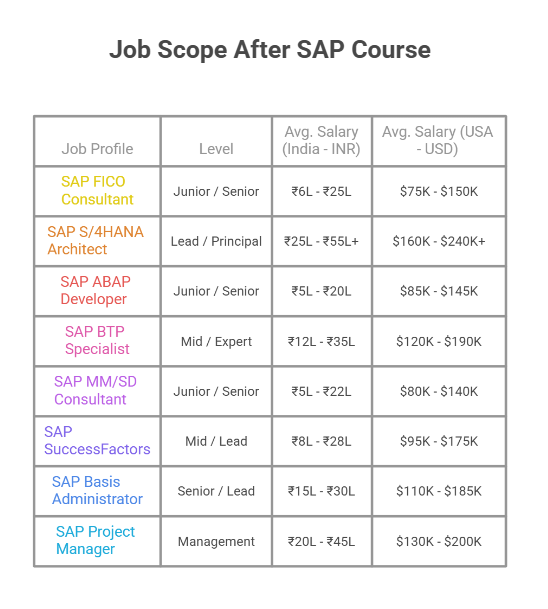
SAP Salary Scope
Conclusion
The best single investment you can make before stepping into an SAP interview process is to thoroughly prepare for your SAP interview questions. As these questions cover core module and technical concepts along with the latest S/4HANA innovations, you would have a well-rounded foundation to ace any SAP interview. Mix in this knowledge with applying real numerical data, an adequate understanding of the business processes involved, and quality training from the Henry Harvin SAP course, and you will be perfectly placed to secure your next SAP role.
Recommended Reads
- What is SAP FICO? Basics You Should Know
- What is SAP Certification? Eligibility, Cost and Advantages
- Henry Harvin SAP Course Reviews
- How to Choose the Best Online SAP Course for Your Career
- Truth Behind the Henry Harvin Certificate Value
FAQs
SAP has more than 25 functional and technical modules. The most sought-after modules for job applicants are SAP FICO, SAP MM, SAP SD, SAP HR/HCM, and SAP ABAP. When preparing for an interview, it is essential to concentrate on the module that is most applicable to the job description you are applying for, and you should be aware of the integration points between your module and the other modules.
Yes, hands-on experience definitely helps in boosting your confidence and authenticity.
It takes around 8-12 weeks to prepare for an SAP Interview.
Yes, it provides training and interview assistance.
Yes, the demand for SAP professionals has reached an all-time high because of the global transition to S/4HANA Cloud and the implementation of AI in business processes