
If you want to be a part of enterprise resource planning, the first thing with which most of you will come is: What is SAP FICO? Indeed, SAP FICO is a vital module of the SAP ERP system as it has evolved to help businesses manage financial data and reporting requirements, enabling them to make informed decisions based on real-time information.
Getting an insight of sap fico is important for those individuals who ever intended to fill the void between traditional accounting standards and contemporary streamlined digital techniques. The SAP FICO full form is Financial Accounting (FI) and Controlling (CO), is two separate but interrelated parts of the organisation that are responsible for external financial reporting and internal cost management. Once you Learn SAP FICO, companies gain immediate insights into their financial standing so that they can make informed decisions and be compliant with regulatory requirements.
In this ultimate guide, we’re going to take a much deeper look at the architecture, advantages and key components of this powerhouse tool.
What is SAP FICO? An Overview
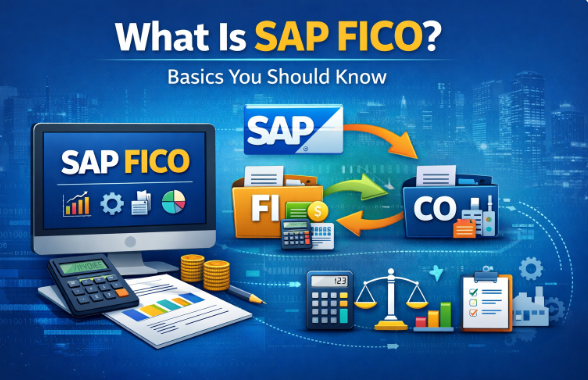
Fundamentally, SAP FICO is a (financial accounting) software tool which organizations use to manage and record their financial transactions. It is not just a “digital ledger” but rather, it plays well with other SAP models such as Sales and Distribution (SD), Materials Management (MM), Production Planning (PP), etc.
The SAP FICO Full Form
To make sense of the system, however, we need to start by breaking down the acronym:
SAP FI (Financial Accounting): Dedicated to external reporting. Every financial transaction a business makes is written to it, allowing the balance sheet and profit-and-loss statements to be truthful for external stakeholders, tax authorities and auditors.
SAP CO (Controlling): This is for internal purposes. It is employed to plan, monitor and execute costs and report on them. It goes a long way for management to know where money is going and how to increase profits.
Core Components of SAP FI (Financial Accounting)
The “FI” part of SAP FICO handles the “external” face of the company. It ensures that every penny is accounted for in accordance with global accounting standards (like GAAP or IFRS). Here are the sub-modules you need to know:
1. General Ledger (FI-GL)
The General Ledger is the central heart of the FI module. Every transaction from other sub-modules flows here in real-time. It provides a complete record of all financial transactions and serves as the primary source for generating financial statements.
2. Accounts Payable (FI-AP)
This sub-module manages all transactions related to vendors. It tracks when payments are due, manages invoices, and handles the actual disbursement of funds. Integration with the Materials Management (MM) module is crucial here for seamless “Procure-to-Pay” cycles.
3. Accounts Receivable (FI-AR)
Conversely, FI-AR manages customer transactions. It tracks sales, processes invoices, and monitors incoming payments. It integrates heavily with the Sales and Distribution (SD) module to complete the “Order-to-Cash” cycle.
4. Asset Accounting (FI-AA)
From heavy machinery to office laptops, companies need to track the lifecycle of their assets. FI-AA manages the purchase, depreciation, and retirement of fixed assets, ensuring the balance sheet reflects their true value.
5. Bank Accounting (FI-BL)
This handles all communication with banks, including reconciling bank statements with the company’s internal books to ensure no discrepancies exist.
Core Components of SAP CO (Controlling)
While FI looks outward, SAP CO looks inward. It provides the data needed for “Managerial Accounting.” If you want to know which product line is failing or which department is over budget, CO is the tool you use.
1. Cost Element Accounting
This provides an overview of all the costs and revenues of the organisation. It essentially defines where the costs are coming from.
2. Cost Centre Accounting
A “Cost Centre” is a department or function that adds cost to the company (like HR or Marketing). This module tracks the expenses of these specific units to ensure they stay within budget.
3. Profit Centre Accounting
Unlike cost centres, profit centres are units that generate revenue (like a specific product branch). This module analyses the profitability of internal areas of the organisation.
4. Product Costing (CO-PC)
This is one of the difficult aspect if SAP FICO. It is a measure of product or service costing. It takes into account raw material, labor and overhead and enables companies to adopt competitive and profitable prices.
5. Profitability Analysis (CO-PA)
The CO-PA allows the profit centre to break down the profit/loss of an organisation according to market segments, depending on customer groups, geographic regions, and products.
Why Is SAP FICO Crucial For Business?
Now that we have answered the question, what is SAP FICO, you may be wondering: Why use it?
- Real-Time Data: In traditional accounting, employers frequently get caught up in the “month-end” rush. SAP FICO gets updated on a real-time basis. When a sale takes place, the ledger is instantly updated.
- Worldwide Compliance: For a multinational corporation, dealing with multiple tax laws and currencies is an absolute disaster. This is automated with SAP FICO, which follows various currencies and legal laws.
- Better Visibility: It gets rid of the ‘silos’ by aggregating data. The finance department can see precisely what the procurement department is up to, minimising the risk of fraud or error.
- Long-Term Planning: Leaders are not only looking at what happened in the past with the “CO” module, but they are also predicting and forecasting into the future based on true cost data.
Integration: How FI and CO Work Together
The best thing about SAP FICO is its combination. In most legacy systems/ERPs, “Accounting” and “Management Reporting” were two separate software systems that failed to communicate.
SAP has the ability, when a financial event (such as paying a vendor) is executed in FI, it can also hit a cost centre in CO. Simultaneously, this guarantees the external books and internal management reports are balanced. It’s the “Single Source of Truth”, and it’s a huge reason why SAP products are used by most Fortune 500 companies.
SAP FICO vs. Other SAP Modules
Aspect | SAP FICO | SAP MM | SAP SD |
Focus | Finance & Control | Materials Management | Sales & Distribution |
Integration | Financial postings | Procurement to FI | Sales to AR YouTube |
Users | Accountants, Controllers | Procurement teams | Sales staff |
Key Output | Financial reports | Inventory levels | Order fulfillment |
Common Challenges in SAP FICO
Challenges of the execution are the migration of data and user training. Customisation can complicate upgrades.
Solutions: Phased release and change management.
Tips for Success
- Involve finance teams early.
- Leverage SAP Best Practices.
- Monitor post-go-live performance.
Career Opportunities in SAP FICO
Because almost every major industry—from manufacturing to retail—uses SAP, the demand for SAP FICO consultants is incredibly high. Typical roles include:
- SAP FICO Consultant: Helping businesses implement and customise the software.
- End-User: Working within a company’s finance department to manage daily operations.
- Project Manager: Overseeing large-scale digital transformations involving SAP.
To excel in this field, one typically needs a background in finance or accounting, combined with specialised SAP training. Understanding the SAP FICO full form and its logic is the first step, but hands-on configuration experience is what truly builds a career.
Skills Required to Learn SAP FICO
What does it take to be successful in SAP FICO? Aspiring learners require both technical and financial expertise.
Important skills include:
- Basic accounting knowledge
- Understanding of financial statements
- Business process awareness
- Analytical thinking
- SAP system navigation skills
Former experience in finance or accounting is a plus for participants.
Who can take SAP FICO TRAINING?
Although anyone with a keen interest in finance and enterprise technology can take SAP FICO training, there are certain backgrounds that will put trainees significantly ahead. As SAP FICO (Financial Accounting and Controlling) is a functional module, it doesn’t really require coding and is open to various functions. Graduation with a basic knowledge of Accounts would be enough.
Below is a breakdown of who should be taking this training:
Finance and Commerce Graduates
This group is most prevalent. As long as you already know the debits and credits and how a basic balance sheet is made, you will have little trouble understanding how the software is programmed.
- Qualification: B.Com, M.Com, BBA and MBA (Finance).
- Professional Eligibility: Students and professionals of CA (Chartered Accountant), CMA(Certified Management Accountant) and CSA (Company Secretary Course) followers.
Working Accounting Professionals
- If you are already in accounts and have to perform manual entry or work on basic Tally software, then “SAP FICO training” will be your real upgrade.
- Accountants & Auditors: Ladder up into lucrative consultant roles.
- Taxation Professionals: For automating GST/VAT and worldwide tax compliance in the ERP.
IT Professionals and Engineers
- Moreover, some people who are deeply technical switch to SAP FICO.
- Software Engineers: Who like to switch into “Functional” TGI Model – So, working as a Functional guy at IT companies.– Point – Is for business, will stay till the end, comes up with facts, what it is and requires configuration in the software Package.
- ERP Consultants : Kre profesionistas que ya estén laborando en otros módulos de SAP (por ejemplo SD o MM) y que deseen ser expertos en “Cross-Functional”.
Career Switchers (Non-Finance Background)
- A finance degree is not a strict requirement to SAP FICO, but can be more challenging.
- Science / Arts Graduates: They do well by first understanding the basic accounting names.
Many training institutes emphasise “bridge courses” (or demo) to make non-finance graduate people understand what an asset is and what a liability is before starting sap module.
Learning SAP FICO: Getting Started
Begin with the fundamentals of accounting. There are platforms like Henry Harvin and IndoBerlin offering courses tailored for Indian students.
Practical exposure through SAP IDES is very important.
Training Roadmap
- Understand FI/CO fundamentals.
- Master configuration and end-user processes.
- Practice real scenarios.
- Pursue SAP certification.
Shoot for 3-6 months of focused learning.
Henry Harvin – Best Platform to Learn What is SAP FICO

The best way to learn what is SAP FICO and to stay updated with the latest trends in ERP, is to enroll into the SAP FICO Course of Henry Harvin. Certainly, Henry Harvin is a leading Ed tech company offering various upskilling and job-oriented courses covering different fields of education. The SAP FICO Course by Henry Harvin is one of the best offerings of the institute. Henry Harvin is a globally recognised institute that helps you get jobs worldwide. Let’s see what makes Henry Harvin the first choice for the students when it comes to SAP FICO training.
Unique Offerings of Henry Harvin SAP FICO Course
- Highly intensive and practical training
- Duration- 44 Hours of Live online classes
- Along with live classes, there will be doubt-solving sessions of 15 hours
- Master sessions of 8 hours by industry experts to give you real-world experience
- Auto-graded assessments to check your learning level
- Capstone Projects and Mini Projects
- Gold membership of Henry Harvin for 1 year
- Mock Interviews
- Internship
- Job Assistance
- Mentorship
- Course completion certificate from Henry Harvin
- Prepare for SAP Certification exams
Conclusion
To conclude, when we ask what is SAP FICO?, the answer is very simple. It is like the nervous system of the financial body of any organisation. When you combine the SAP FICO full form, which is Financial Accounting and Controlling in one unified solution, organisations can leave manual spreadsheets behind. Moreover, they will never look back to make way for an automated, dependable tomorrow of financial intelligence that’s actionable. Whether you are a company that is growing, an organisation with aggressive plans for growth or an experienced decision-maker, SAP FICO has the solutions you need to succeed in the new digital economy. Furthermore, these organisations are in search of skilled and certified SAP FICO professionals who actually have real-world experience. That’s why enrolling on the reputed and recognised SAP FICO training can help you in getting these high-paying jobs.
Recommended Reads
- What is SAP Certification? Eligibility, Cost and Advantages
- Henry Harvin SAP Course Reviews.
- What is SAP and Benefits of SAP Software?
- SAP FICO: Overview and Uses
- Best SAP MM Course in Dubai: Duration, Fees, and More
FAQs
Ans- Those pursuing ERP careers that are a good fit include finance graduates, MBAs, accountants and IT pros. Previous experience with SAP is not required, but beginners might benefit from having a basic understanding of finance.
Ans- Classroom / online courses take 2-3 months, while fast-track courses can be completed in 4-8 weeks. Self-paced go up to 3 – 6 months with unrestricted access.
Ans- Fees alone can be ₹30,000-₹1,00,000 (though that depends on the institute as well as the location and mode). Online training is inexpensive (e.g. ₹8000-₹50000) compared to SAP official certification (in excess of ₹60000).
Ans- Most of these courses include hands-on practice of the tools and techniques that are learned, including other modules as well as a 6-8 week self-study for SAP Associate certification. Job placement and credibility are recommended most when it comes to certification.
Ans- Yes, Henry Harvin offers resume building, interview prep and placement assistance. They generally place candidates in jobs such as an FICO consultant with very competitive salaries.