How Doctor of Business Administration Programs Shape Future-Ready Business Leaders?

In an era of unprecedented disruption — artificial intelligence, geopolitical shifts, climate imperatives around sustainability, and the collapse of traditional industry boundaries — organisations don’t just need experienced managers; they need scholarly leaders who can translate rigorous research into strategic action. This is precisely what a well-designed Doctor of Business Administration (DBA) program delivers.
The Doctor of Business Administration is a professional doctoral program that prepares business students to understand, apply, and analyse advanced research methodology at a level required to contribute original research to the field Doctoral Programs in Diplomacy. The act of sending one representative over to the other side, for example. These programs combine cutting-edge research, real-world applications, and strategic leadership training to ready executives for an ever-evolving tech-driven global economy.
What Is a Doctor of Business Administration Program?
The Doctor of Business Administration or DBA Degree is a terminal applied-research doctoral degree in business administration, which can be pursued by those who already hold a Master of Business Administration (MBA.) degree. Not to be mistaken with a traditional PhD in Business (focused on theory and academia), the DBA focuses on addressing business challenges based on evidence-based decision-making processes and real-life projects.
Most DBA students are mid-career, often senior professionals looking to gain intellectual depth and challenge with a research-based degree while maintaining their professional careers. And with many schools now providing flexible or online DBA formats, busy executives will be able to more easily balance work commitments and personal duties while completing their studies
How Doctor of Business Administration Programs Build Strategic Thinkers?
DBA programs can be particularly concerned with building strategic thinking and high-level decision-making skills. All this implies that students go through global strategy, innovation management, digital transformation and executive decision-making for the AI era , experiencing what is happening in real practice on the ground.
Using case studies, simulation exercises and consulting-type projects, students develop the ability to analyse complex business landscapes and offer long-term management strategies that are compatible with an organisation’s objectives. This kind of strategic thinking is essential for C-Suite roles, board positions and senior consulting opportunities where leaders have to juggle risk, opportunity and stakeholder expectations.
1. Applied Research for Real-World Impact
The hallmark of many Doctor of Business Administration Programs is applied research. Rather than process-based dissertations, DBA candidates typically complete research projects addressing actual business challenges–from enhancing supply chain resilience to driving digital transformation and customer experience redesign.
Attendees will learn advanced qualitative and quantitative research methods and apply them to their own organizations or industries, resulting in practical solutions that can be immediately applied. It has the added virtue of accruing measurable value to employers and business ecosystems, not merely to a learner’s career.
2. Future-Focused Curriculum and Emerging Technologies
Doctor of Business Administration Programs are more and more focused on themes for the future, such as AI in business strategy, data analytics, digital transformation and leadership in the Fourth Industrial Revolution. Class topics can include insights from big data for business, predictive analytics, innovation management and technology-driven business models to help executives stay ahead of the curve.
Through engagement with tools, frameworks, and project case examples, students gain a sense for how to grasp the opportunities presented by new technologies in ways that can create competitive advantage. This arguably prepares DBA graduates even more effectively for situations in which firms need to perpetually reposition themselves against disruption and changing market assumptions.
3. Leadership, Ethics, and Global Perspective
DBA Programs not only develop technical or analytical skills, but they also build ethically sound and globally sensitive leaders. Numerous curricula include special modules on ethical leadership, corporate social responsibility governance, and value-based decision-making to develop leaders with integrity. Furthermore, DBAs also tend to focus on global business concepts, cross-cultural management and international market structures. So that leaders can apply these with confidence in the increasingly multilingual -multinational environment. That blend of ethics and universalism is essential for establishing sustainable organisations and reliable brands in a connected world.
Key Skills Developed in Doctor of Business Administration Programs
Doctor of Business Administration Programs enable senior executives to polish a potent blend of strategic, analytical and executive skills. Some of the main features implemented are:
- Advanced strategic analysis and long-range planning in complex, uncertain environments.
- Fact-based decision using both qualitative and quantitative analysis, data analytics, and business intelligence.
- Change management and innovation leadership, orchestrating change across functions and geographies.
- Ability to influence Boards, Investors, Regulators and global teams. Executive communication and stakeholder management.
- Develop thought leadership via published works, speaking, teaching and consulting based on original applied research.
They prepare DBA graduates to serve as credible scholars capable of translating knowledge into practice at the highest level.
Career Prospects and Job Opportunities After a DBA
Graduates from DBA Programs frequently enter or enhance their position in C-suite leadership. Big picture many move into C-suite roles, like: CEO, CFO, COO. Moreover also others may lead biz units/biz areasinnovation might be the leader of a transformation office.
A few holders of DBAs go on to create portfolio careers(mixing executive jobs with consulting assignments, board memberships and executive education or adjunct teaching). With their strong blend of real-world experience and doctoral-level understanding, DBA graduates are also in demand as industry leaders, consultants, and subject matter experts.
Doctor of Business Administration vs PhD in Business
A common question is how Doctor of Business Administration Programs differ from PhD Programs in business. While both are doctoral-level qualifications, they serve different purposes:
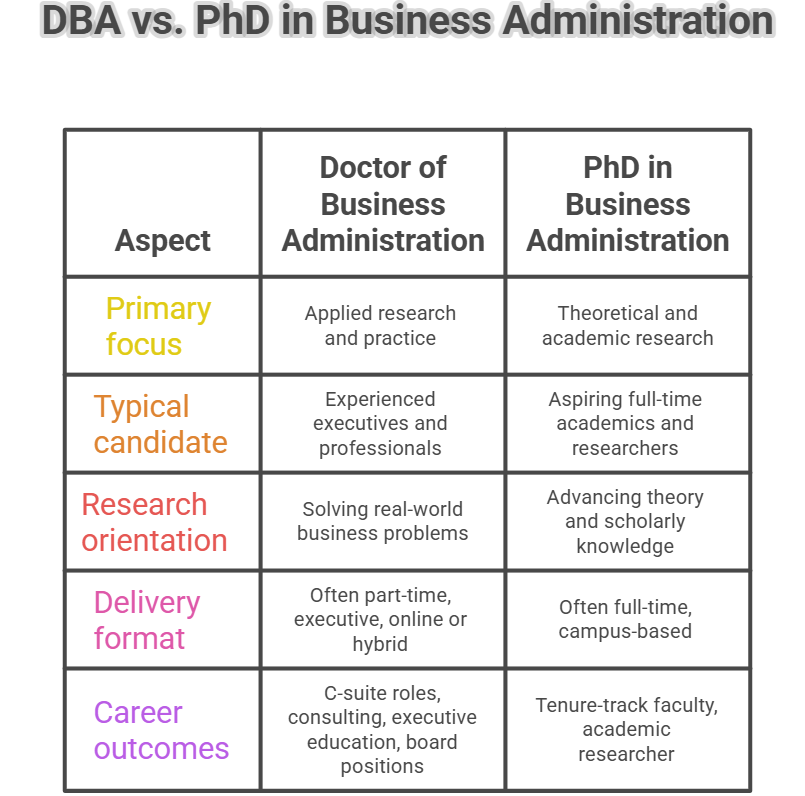
Doctor of Business Administration Programs are the best way to go for professionals who wish to stay close to industry and practice, but at the same time pursue an academic pedigree that is second-to-none.
How to Choose the Right Doctor of Business Administration Program?
Choosing your doctorate degree online is a decision that will impact your path as an impactful leader. When comparing options, consider:
- Accreditation/reputation of the business school / university.
- Curriculum that fits your goals — consider specialisations in leadership, marketing, information systems or healthcare administration, for example.
- If you are a working professional, format and duration flexibility (online/hybrid/executive weekend model).
- Good measurement of faculty quality, industry ties and backing for applied projects.
- Networking with peers, alumni and industry partners who may be able to help you land your next role.
Selecting a solid, forward-focused Doctor of Business Administration program prepares professionals to become future-ready business leaders. They will be able not only to innovate and navigate disruption but also to create sustainable value in the international marketplace.
Henry Harvin-Best Institute for Doctor of Business Administration Programs

Indeed, Henry Harvin offers online doctoral programs that are globally recognised and will enhance your career prospects. Henry Harvin is the top choice for the online/professional Doctor of Business Administration Programs. Especially, you are working executives looking for a flexible, employer-focused doctoral track rather than traditional campus-based PhD paths. Its DBA programs derive from global partner universities, extended research support and a 10-in-1 EdTech ecosystem that focuses on competency academia career progression to senior professionals.
- Online, flexible Doctorate of Business Administration for working professionals with a busy lifestyle.
- International collaboration with Dunster Business School and others, bringing international standard DBA qualifications.
- Available in specialisations of Business Strategy, Organisational Leadership, HR, Marketing, Finance and Innovation management.
- Sound research training in qualitative and quantitative methods, data analysis, and dissertation/thesis direction.
- 10-in-1 program model including masterclasses, gold membership sessions, and recorded sessions with post-training support.
- Individual guidance and supervision of Doctoral Dissertations by accomplished faculty and professionals.
- Intended to train students for upper-level roles such as CEO, COO, consultant, and higher education or corporate trainer.
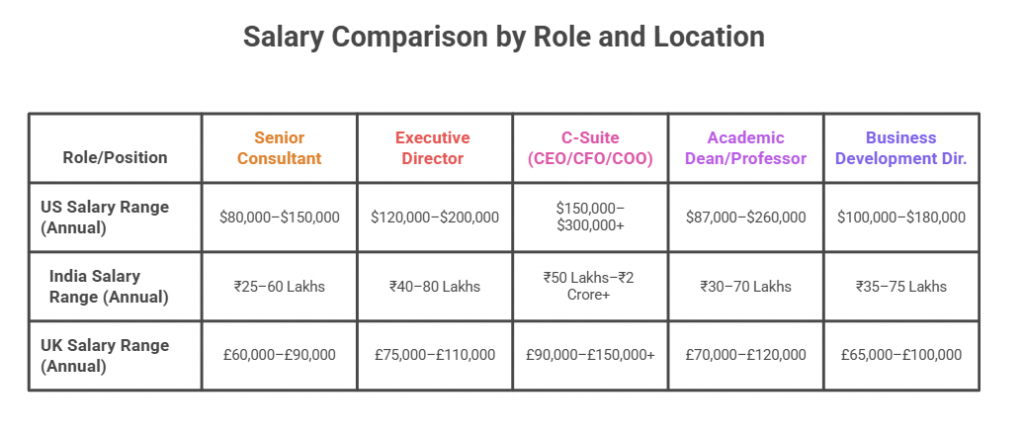
Salary Scope After Doctor of Business Administration Programs
Conclusion
In summary, indeed, the Doctor of Business Administration Program prepares the managerial leader to excel in an ever-growing global market. They build the strategic insight, data-based decision making, emotional intelligence and innovation leadership. These programs turn seasoned managers into ethical, adaptable business leaders. These leaders are able to deliver results and make a meaningful impact on the world while bringing together diverse stakeholders in sustainable endeavours. For an ambitious leader who seeks to have the C-suite influence and require thought leadership, a DBA is nothing but the best catalyst for future-ready success.
Recommended Reads
- Professional Doctorate in Business Administration
- How Long is a Business Administration Degree?
- Honorary Doctorate vs. PhD: Key Differences Explained
- Dunster Business School Partners with Henry Harvin®, UAE
FAQs
Q1- What is a Doctor of Business Administration?
Ans- The Doctor of Business Administration (DBA, PsyD or DrBA) is a terminal professional doctorate in business administration. It is focused on the practical application of theory through the use of advanced research. Especially at senior roles and executive levels.
Q2- What is the difference between a DBA and a PhD in Business?
A DBA is applied and tailored for professionals with several years of experience wanting to address or solve a specific company´s problems, lead a whole organisation on their own, whilst the PhD in Business tends to be theoretical and inside academia, preparing candidates for academic as well as full-time research based educational jobs.
Q3- Who should consider a DBA degree?
DBA programs, then, are for mid- to senior-level managers and executives, entrepreneurs and consultants with master’s degrees (usually MBAs), making a pair of moves: deepening expertise and influence while beginning the transition into strategic or thought-leadership positions.
Q4- What Do I Need in Order to Apply for a DBA?
Most institutions require a relevant master’s degree, several years of professional and managerial experience (as many as 5–10), most prefer a good academic record, and an explicit statement of research or professional interests; some may require interviews, such interviews usually serving goal-based conversations through which the interviewee can establish potential working relationships with their PhD supervisor.
Q5- Is there a thesis in a DBA?
Most of the DBA programs have either a major research project or a dissertation, where you study a major business problem in detail and provide practical recommendations that can be applied in organisations.
Ready to Build Your Career in the UAE?
Industry-focused programs with expert trainers, flexible batches and placement support.

Written by
Nidhi Gupta
Hi! My name is Nidhi Gupta, and I am a Versatile Content Writer skilled at crafting SEO-optimized and informative content related to various areas of life. In particular, I can write about SAP, foreign languages, certificates, healthcare, technology, education, and careers, among others. Being a research-oriented writer, I make complicated ideas simple for readers by providing relevant information in an easily comprehensible way. Thus, my expertise includes writing articles, blog posts, website pages, and other forms of content based on research. Along with writing, I find it interesting to mentor novice writers and provide helpful tips on content writing, SEO, and communication skills. Be it a technical or any other topic, I always do my best to craft accurate and high-quality content.